Steeky Fingers

First let me thank you, Gentle Readers, for weighing in with your opinions on seeing or not seeing the blood-and-guts process of making the Frog Prince.  It seems that most of you would like to see me break the eggs, in the hopes that I get an omelet.  It is rare that I can show you all the steps it takes to get a finished design.  Most of the time, my projects have been sold to a yarn company or a publisher before they are even born, and those people cleverly require me to keep my process under wraps until they are ready.  This project, however, I have saved especially for you.  Won't you join me on my Odyssey, and feel free to post questions as we go?

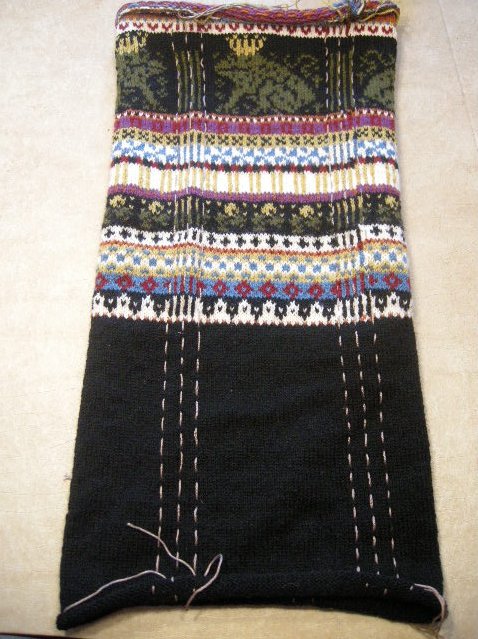
Here we rejoin the Frog Prince panel-tube in progress.  You can see my cotton yarn markers for the steek stitching and cutting lines. These are to help me see exactly where to stitch, and then cut the steeks.  Traditional construction would have only one vertical steek (in the center front of a cardigan), but since the Frog Prince is special (Weird?), it begins with a tube made of three conjoined panels, and three steeks.
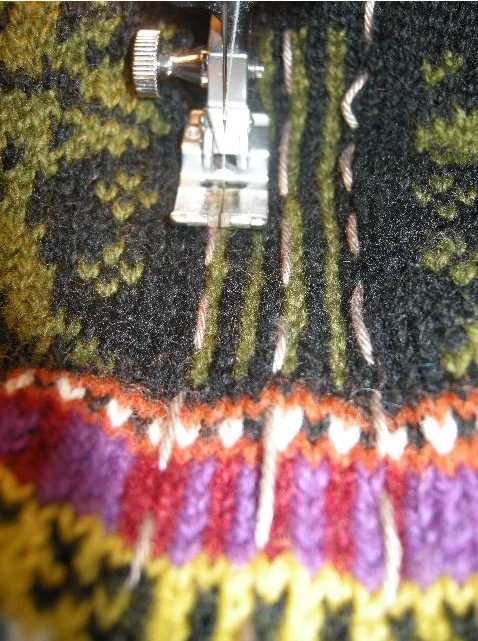
Here I am machine-stitching the first of 4 vertical lines made on each of the three steeks.  The machine-stitches go right down the valley between knitted stitch columns, securing the steek.  Pure Magic.  Steeks can be stitched in several different ways, each with advantages for various applications.  I chose to machine these, since I will be handling the raw edges quite a bit before finishing them.  A crocheted edge would be equally durable, but takes (me) a lot longer and adds more bulk than I need since it will ultimately be covered.
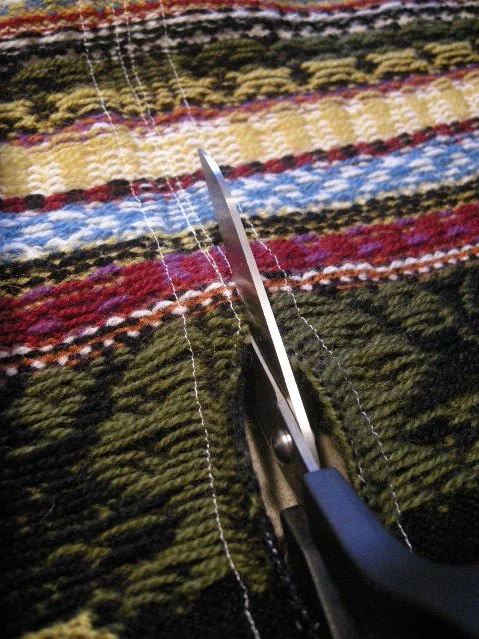
Warning: Yarn Carnage!  Sensitive viewers may need to skip this shot.  Braver souls will note that the 4 vertical stitching lines are clearly visible from the wrong side of the work.  I usually cut steeks from the back for this reason.  Any advantage you can get when scissoring a sweater, yes?  I slice right between the middle two stitching lines with extremely sharp dressmakers shears.  By the way, even though I have performed this maneuver many times, I still hold my breath.
Eggs broken, Omelet Begun.  Here are the three Frog Prince panels, no longer conjoined.  I wash and block them just as I would any other sweater parts.
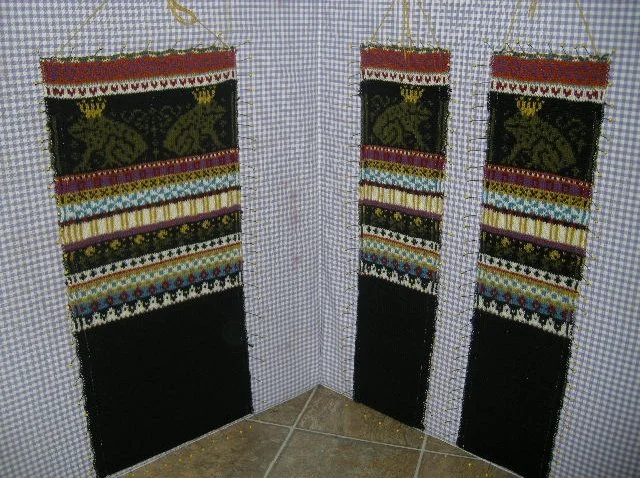
For those who have asked, this yarn is Rauma Finullgarn (translation = Fine Wool Yarn) from Nordic Fiber Arts, where you will eventually be able to purchase the Frog Prince Kit.  This yarn is the Real Deal, as far as Scandinavian knitting goes: Gorgeous, traditional colors, perfect stranding behavior, and just sticky enough to steek like a champ.  And we wouldn't expect any less from the descendants of the geniuses who made up stranded colorwork, now would we?

This is two-ply yarn, working up at a guage of 7sts/in on a US size 3 needle, in case you are wondering.

Join me next time, in which I plan to slash a throat.  Or shape a neckline.  Whichever.
 

The Red Faery Sings

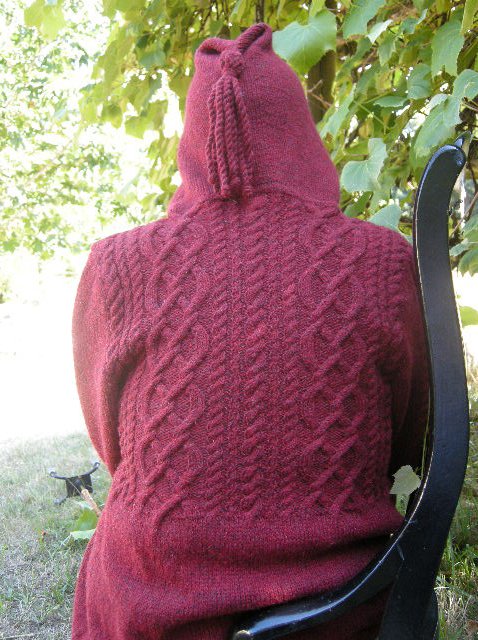
I now present the Red Faery, as promised (gamely modeled by my mom on the occasion of her 76th birthday):

Was it worth my struggle to the finish line?  Sewing in the sleeves on the ferry to the island?  Stitching on the buttons in the dark of the night before Mom's party?  You bet your sweet Faery Ring.
 

Crawling to the Finish Line

Someday (may be the last thing I ever do), I'm going to finish a project before the final possible second.  The Red Faery is not that project.  It's Friday, and I'm headed to the island for a desperately needed vacation with my family.  There's a birthday party for my mom on Sunday, and I'm going to be knitting in the car, on the ferry, and probably in the dark of night, too, in order to give her a present that actually is finished.  The irony is, of course, that I'm killing myself to finish this sweater in time for her birthday IN AUGUST, when it's much too hot for her to wear it.  But that's not what this is about, for me. 

A while back I "turned pro" as a knitter.  That is to say, I started writing about the knitting I do, and the people I know who also do it.  I made a book about it, and people started to call me things like "Designer" and "Author".  My professional status was more a result of not stopping them from doing that than it was actually having achieved some benchmark.  In lots of avocations, there are certificates, or even licenses you can earn, stick in frames, and hang on your wall.  Knitting doesn't have that kind of tangible proof, outside the actual sweaters and socks.  I'm totally okay with that, not being the sort of person who's much impressed by framed certifications.  I just roll with it, and hope that nobody asks me a question I can't find an answer to.  So far my strategy is working.  I can tell this, because I have noticed that I will probably never be able to just knit something for the heck of it again.  My knitting time has become totally devoted to people outside my immediate circle of friends and family.  I knit for yarnmakers.  I knit for book publishers.  I knit for other knitters whom I may never even meet.  And it is wonderful.  What better validation and affirmation could I ask for?  There are just these little times when I wish I could make my mom a birthday sweater without an unusual planetary alignment, or an act of Congress.  I'd like it if I could make that little doll sweater for Lindsay before she outgrows dolls.  Campbell should have two mittens, not one.  And don't even ask me what the last thing I made for Phillip was.  Can't remember.

So getting this project done for my mom is not just a triumph of will over day job.  It's proof to me that I can still make room in my priority queue for the people I love.  And that's why a box of disembodied sweater parts for mom's birthday simply would not do.  Here are the sleeves, by the way:

You may notice that they are neither seamed, nor attached to the sweater.  Still.  I'm gonna make it to the finish line.  There's like hours to go before the party.