Feeling Kilty

I'm starting to think about all things Festive, which always puts me in mind of Highland Dress.  Hogmanay is coming, after all, and I wouldn't want you to be caught unprepared.

So in honor of the spirit of my ancestors, I give you

"Kilt By Association"  CLICK HERE for the pattern.

These are big fun to knit, and the pattern includes lots of information on how to customize their fit.
 

Kilts and Kilt Hose are the exclusive domain of Gentlemen, in Scotland.  Ladies officially wear Kilt Skirts, which contain about half as much fabric, and fasten on the opposite side.  Their legs are covered by tights or stockings, rather than hose.  In Scotland.  But since I'm actually American, I break the rules.  My ancestors are dead, and even if they weren't, it would be a mighty long trip for them to come here just to slap my wrists for going in drag. 

The fact is, Kilt Hose are Dead Sexy, and cozy warm, to boot.  No wee lassie should be denied the luxury.  So I hereby give you ladies permission to make and wear your very own kilt hose, if you want to, and tradition be damned.  I'll take the rap for it when I meet up with my forefathers, at that great distillery in the sky (or wherever else we all end up).

Oh, and Bailey would like me to assure you; This Pattern is Scottish Terrier Approved.

Reverse Engineering a Frog

You remember this one:  Once Upon a Time, I made a tube of knitting, and cut it into panels, then appliqued them onto a boiled wool jacket.  I've been trying ever since to figure out how to make a knittable sweater pattern for you from it.
 

You might also remember that I completely finished said knitted sweater once, only to decide that it was a toad, and banish it to time out.  For around two years.

God love you, Gentle Readers; knitters have long memories.  I get reminded at least once a week that I promised to make this happen, and that I have not yet done so.  I'm so happy that you won't let me get away with giving up the Battle of the Frog.  I know that once I figure this one out, you'll be really proud of me.  And you have been SO patient.  I went back into the pond, so to speak, to think like a knitter, and try sorting it out a different way.

I decided to work out the best shape for every piece of the sweater, and then choose how to knit each piece most easily.  As for the original, the stranded colorwork part should be worked as a circular tube:

Arc.1.jpg

Then we should cut the three panels apart, and shape the neckline curve by cutting it:

Next, we can join the shoulder seams, then pick up and knit the collar around the neckline curve.  The collar is best worked circularly, too:

The collar will have a solid self-facing, (which I didn't draw) for stability, and we can shape the whole thing a little bit by changing needle sizes a few times to get a more funnel-, less cylindrical-shape .  After cutting the collar steek, we'd fold the facing inside and stitch it down. 

Other than the turn-back cuffs (which I'll get to), the rest of the piece is all solid black, which is one of the things I love about it - the stranded parts sort of stand alone, framed by their solid background.  Another thing I love about the original is its sexy, feminine shaping, both at the waist and gathered sleeve heads.  The best way to get those pieces right is to work them flat, like this:

But of course, the cuffs are stranded, so they should be worked together in a tube, then cut apart:

Then sleeves with gathered tops can be worked flat, up from those:

Arc.7.jpg

The whole thing would then be sewn together, with appliqued ribbons and whatever other gee-gaws I can't resist slapping on (Nothing in Moderation; except Moderation).

The only question left is:  Am I the only one crazy enough to make a sweater this way?  I imagine those of you who have been through my "Sexy, Shapely Steeks" class will see how it could work.  That's the class where we deconstruct different knitted shapes to see where steeks could be added to make easier, more fun, and sexier knitting.  But I'm worried the rest of the world might come after me with torches and pitchforks, once they read the pattern. 

What do the knitters think?  Is this mixture of construction techniques intimidating, or something you'd happily attempt? I could just simplify the whole thing by making a drop-shoulder, stranded-all-the-way-around cardigan. But that would be a completely different sweater than the original.  I'd never want to underestimate the power of knitters to make what they want to make.  But I don't want to cause anybody's hair to fall out, either.

Weigh in, won't you, O Friends With Opinions?

Dicentra's Doyenne of Dye

Lisa Millman of Dicentra Designs loves us, Gentle Readers.  And I can prove it:

No less than FIFTY (50) pounds of yarn, lovingly skeined and meticulously sorted for my Eeek! Steeks! students' homework kits.  You are going to LOVE this yarn.  I promise.  And more than that, you're going to love knowing more about Lisa.  The only thing better than gorgeous yarn is feeling a little closer to the artist from whose hands it comes.  Lisa graciously agreed to let me interview her:

How long have you been dyeing?

I've been dyeing seriously since around 1996, so about 16 years (wow, it doesn't seem like it's been that long!)

Where do you live?

Just outside Dallas, Oregon (also known as "Little D") in the foothills of the Coast Range on a nano (smaller than micro) farm.

Got any kids/pets/houseplants/partners you share life with?

No two-legged children. Two four-legged children (dogs BB, a beautiful German shepard mix, and Xena, a small black Labrador). Partner: Alex, a writer and idealist. Houseplants: a 16' x 10' greenhouse/leanto shed filled with epiphyllums, which are tropical cacti with flat, long, straplike leaves that live high up in trees and make gorgeous, giant, sometimes fragrant blooms once or twice a year, including night-blooming cereus and a bunch of hybrids that have large colorful blooms once in awhile.

What's your day job?     Land use planner.

Is your family here in the NW?

No. I have a niece in San Francisco, brother in Maryland, sister and mother in Maine. I'm a true Yankee born in Connecticut and raised in New Hampshire. I migrated to Florida after graduating from college in the 1970s and then set my sights on the West Coast about 17 years ago.

What would you do if you ever got spare time?

I'd travel. Iceland and Middle Earth, otherwise known as New Zealand, are high on the list. Go to Europe and Australia to do some felting and dyeing with the excellent artists who live there. Also, I'd spend a lot of time making felt, spinning, knitting, and weaving the fiber I dye into works of art and exhibit the art in galleries.

Anything you'd like to tell the knitters about the process of making these gorgeous kits...

Hmmmm, dyeing the yarn for these kits has been so much fun, in part because the colors are tints, tones, and shades of my two very favorite hues: green and purple. Some of the colors are old favorites, and I also came up with some new colors I haven't used before. The range of tints needed for the kits challenged me to come up with some very pale colors, which I don't do frequently, to the midtones and saturated jewel tones that I most love. I don't often dye on commission, usually preferring the freedom of responding to what I am seeing outside in my yard and on hikes in the woods, music I am hearing on the radio, and occasionally even checking color forecasts for the fashion industry and translating those into color on wool and silk. The challenge of talking about color with another person was made easy in part by the clear and well thought out initial draft of the project we started with and the creative space I was given to interpret the thistle motif in color. The beautiful charted thistle pattern instantly got my creative juices flowing and the thistle photograph that came with it was the perfect starting point for choosing the particular purples and greens that would complement the design.

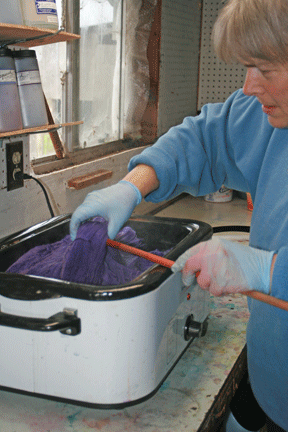
I have converted a wood shop into a dye studio with three electric stoves, and an electric roaster I use for sampling colors and dyeing small quantities of fiber and yarn, along with a washing machine used to rinse the dyed fiber and yarn. I dye in fairly large batches and can get around 36 pounds of yarn steaming at a time at full capacity. In the winter, the yarn comes inside the house to dry, looking like stalactites hanging from the ceiling in the room with the pellet stove. At almost 2 pounds of yarn per kit and 39 kits and counting, about 70 pounds of yarn needed to be dyed in 6 colors, and then wound off into the amounts of each color needed to complete the Thistle Stole. At this point in the Thistle Stole Project, most of the dyeing is done and the 3-skein electric skein winder is whirring in concert with three umbrella swifts to produce the 234 skeins needed for the kits.

Now I'm thinking about all the stunning Thistle Stoles that will be created from these kits, each with its own particular personality influenced by all the hands that touched the ingredients, and proud to have a part in bringing some loveliness to the world.

CLICK HERE to Visit Dicentra, and be sure to check out the "Shows and Shops" tab to learn where Lisa will be next.