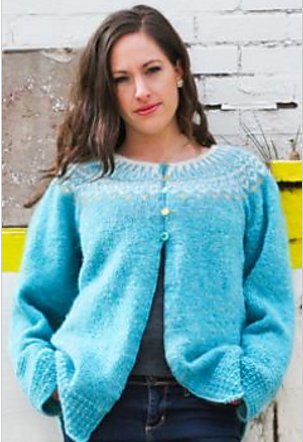
Stalled

As I predicted, I ran out of my main color yarn. By exactly seven (7) rounds,

@%*)#%&+! 

@%*)#%&+! 

The good news is threefold: 1. More black yarn is on its way. 2. The last 7 rounds of black will be somewhat obscured by their location in the very Disco, busily-patterned yoke.  So if the new dye lots are different, it will (ostensibly) be harder to tell.  3. I have cleverly determined exactly how much yarn is required for this size at this gauge. So you don't have to. You can confidently proceed to knit this size, and all the ones smaller than this, with the amount of yarn I state in the pattern. Everybody making one bigger than this, you're on your own. Just kidding! I promise to get those right, too. Just one more service I provide.

I'm always convinced, when I join the sleeves to a yoke sweater, that the whole thing is way too enormous to fit any human being. Which makes sense, if I use Maths: I have added a further 120 stitches to the carefully-calculated largest point of the torso. It's okay. Being scared (or convinced of failure) is part of the knitting design process. Nobody ever said this sport was for weenies. 

Doesn't it look like a weird peasant blouse? Just sayin.

I Can Stop Any Time I Want

You can always tell when I have something pressing and important I'm supposed to be doing: 

I work compulsively on an unrelated thing:

Fugl Redux needs only two more inches on the body. But I got bored with that and started some sleeves. They're nice and sleevey, just the way we like them. I tried one on for length when it was 93 degrees outside, prompting Lindsay to make disparaging comments about my sanity. I'd accuse her of being a Muggle, but she's a knitter, too.

It looks like I've pulled a Mary by ordering less black yarn than I need, so I've ordered more. Along with a feeble note to Customer Service about possibly matching the dye lot from before. I have no confidence that's possible, but we'll see. Hopefully I can hide any mismatch within the yoke pattern (?). I wish I could figure out why I'm such a slow learner with regard to yarn estimation. I'd say it's that I'm constitutionally optimistic, but I think we all know that's not true.

In other news, the very clever reader Michele responded to my question about the typical 2-st steek specified in Icelandic patterns:

This is Ragga's take. She crochets her steeks, too, but only knits one (1!) extra column of steek sts, leaving the crochet chain exposed as part of the design. You can see in the video that all the little cut ends of the stitches hang right out there when the cut is first made. She vaguely alludes to covering them with ribbon later, which would serve as additonal reinforcement. But covering a crocheted steek is like adding a belt to your suspenders, in my mind. In the end, we're relying on the properties of the Lopi wool to fuse and become buttetproof, but that doesn't happen on the day you cut. It takes a bit of washing and wearing before that magic takes place. During which time I will have picked up and knitted a placket next door to it, causing all sorts of nasty blowouts. So I'm going to revert to type and stick with my extra-steek-width plan. 

Many thanks to Michele for pointing us to Ragga's excellent video! Ragga also has a Craftsy class on working a Lopipeysa from the top down, featuring a really pretty pattern which I'd love to knit sometime. I especially love the way her buttons are only on the yoke part of the cardigan:

Photo by Ragga Eriksdottir; Craftsy Class HERE

Photo by Ragga Eriksdottir; Craftsy Class HERE

It would be particularly flattering on narrow-shouldered-curvy-hipped figures.

How about you, Gentle Readers? What are your Lopi Dreams and experiences?

Mind the Gap

I'm done with the springtime shell (name withheld to protect its innocence), and here it is in all its unblocked glory:

Wrong.JPG

Normally I would do a lot more to photograph a new project than drop it on the floor, but I made a bold decision about this in the middle of the night: I'm actually NOT done with the springtime shell.

I have to frog it back to the armholes. It's gonna hurt. But not as much as disliking it the way it is. I fell prey to the classic blunder: I made an armhole that gaps at the bust. And by "gaps", I mean "serious side-boob peep show" Eeewwww. So disappointing. But, there it is; I jacked it up, and there's no crying in knitting. What's really blowing my mind is that I knew it was going off the rails somehow, but I still pressed on until all those fiddly edgings were done, and I even wove in the ends, as if that would somehow improve all of the structural problems.

A deep breath and a critical appraisal in the light of day resulted in the following diagnosis:

Right.png

The notes in white (on the left) are the things I think went wrong. The ones in yellow are my plotted corrections.

A little research into the dangerous territory of bust darts (which I admit, are not my favorite thing in the world), yielded the following gem of an article by Friend of Knitting Amy Herzog:

Why You (probably) Don't Need Short Rows

Thanks, Amy! I had a sneaking suspicion that short row bust darts don't really solve all problems, and now I can prove it. Amy's elegant solution is to add more stitches vertically, which I can totally hide adjacent to the center panel, and then take them all out a few rows later. Poof! More coverage up front, and hopefully no more armhole gap.

And although I never thought I'd hear myself say it: The picot edgings on the armhole and neckline are totally not working here. I'm going to have to change them to something with a little more backbone.

Having emotionally committed to the frog-out, I'm actually looking forward to getting this fixed. It's like an itch I have to scratch.

Sure do wish I hadn't woven in all the ends, though.