Once Upon A Sweater Vest

As we all know, it’s a rare piece whose maker can say is the best example of all things. Nor should it be, because that’s too much pressure to put on mere mortals with string.

But there are some knitted things which serve as useful examples of certain concepts.

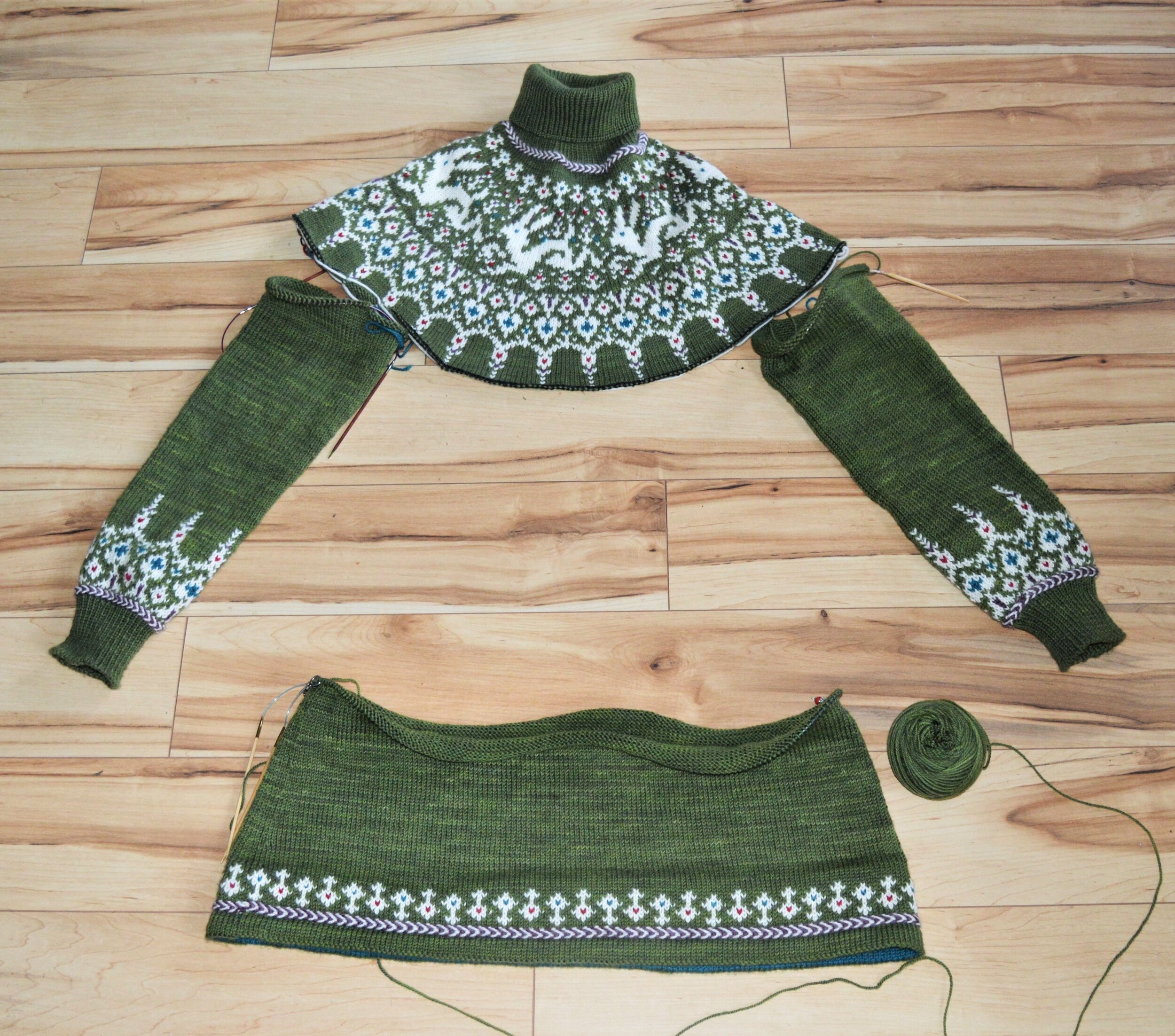
This is one such garment. Flower of Nepal is a little sweater vest I knocked out to wear on tv once, when I learned there are colors and silhouettes that cameras hate. There was little time to spare (surprise) and even less yarn (natch), but lunatic that I am, I elected to knit something new. I used the opportunity/challenge to bang out a vest, with several experimental elements. I didn’t bother to write down any pattern notes, thinking that I wouldn’t need or want to publish the design. Given the unreasonable timeframe (about a week), I would be lucky to get a garment at all, never mind one worthy of the full “pattern-I’m-going-to-sell” treatment.

But it ended up that I quite liked the little vest. Some of the things I tried out on it were successful enough that I began to include it in my sample collection. I only showed it to my steeks students, and usually not on their first introduction to my circus: It’s a little bit thinky for the uninitiated. But for my experienced/returning students (Repeat Offenders), it’s a useful example of some advanced ideas. To wit :

  1. The power of knitted hems to both display repeated motifs and add structure to an otherwise simple shape

  2. The magic of shaping adjacent to cuts in knitted fabric (a cornerstone of my Shapely, Sexy Steeks class)

  3. What happens when sock yarn can becomes a garment, with certain yarn characteristics accounted/adjusted for

A funny thing happened when the students got to play with it: They touched it, they tried it on, they liked its simplicity and ingenuity. They wanted the pattern. And by “wanted” I mean “suggested assertively that I get busy and make it happen, already”. I tried to argue that there were enough things I didn’t like about the vest that it wasn’t appropriate for public consumption. That while a useful example for class, it had elements which limit its knitability/wearability/appeal, and would have to be completely reworked. That its stash-dive yarn combo could not be reliably replicated by knitters.

My protestations were dismissed.

After a few repetitions of this exercise, I understood that resistance is futile. Like everything in knitting, it only hurts worse if you struggle. I pledged to rework the whole design, not just as a canvas for techniques, but as a carefully crafted and sized garment. One that would be both fun to knit and beautiful to wear. In short, one that is worthy of my knitters.

But the yarn problem remained: How could I replicate the strange and unusual color combination? What yarnmaker would sign up for such folly?

Enter the lovely and talented Kerry Graber of Jorstad Creek. Without trepidation, she took my little vest to her studio and worked all manner of magic. She chose the perfect base, and waved her wand over simmering cauldrons of color until she manifested this:

Did you ever? Me neither. Stunning doesn’t begin to describe it.

Once I had these gorgeous jewels in hand, I set about reworking the design. Stay tuned to see the process of how I reverse-engineered my creation for you, Gentle Readers. I think you’ll enjoy the ride.

Shapely, Sexy Steeks

You may have heard that is possible to grow a human ear on the back of a mouse. So obviously, in my head, this translates directly to knitting. What if I grew a sleeve on the side of a body tube?

When we knit with steeks, an enormous world opens up with regard to how we create the parts of garments. For example: What if my new Fana sweater were equal parts green with white, and white with green, in a color blocked arrangement? Something like this:

I need some sweater parts in both color arrangements, notably left body tube, right body tube, left sleeve and right sleeve. The reversed charts are like this:

Fana 2.0.jpeg

And here’s a little sketch for how the color placement might look:

Stay with me now; it’s about to get thinky. Let’s say I want to knit a round where the chart colors reverse in the middle of the round. Each time there’s a single-color round (lots of times in a striped Fana), I’d have to physically switch yarn sources in order to have the proper strand in place when I come back to it in the round. That’s intarsia, which we all know is a Dark Art.

Nope.

Instead, I can make two tubes of knitting; one in each of the color configurations. Each of my tubes will become one half of the body, and one sleeve, once I cut them apart.

Fana 1.jpg

The sleeve needs to be longer than the body, so I started it first. Then I cast on more stitches for 1/2 of the body tube with some waste yarn, and joined the round with steek stitches on either side of the sleeve. As I work away, I can decide on the exact sleeve shaping. Since I’m just knitting sweater pieces, which happen to be conjoined, I can make specific decisions about the way each piece is shaped as I go.

About halfway along the first sleeve, I’ve decided I want gathers up at its cap. For that I’ll need more sleeve width, so I’ll start increasing at shorter intervals now. All the while, I’m also making half of the body tube with every round. The body tube halves don’t need any shaping in this case, so they’re just straight-sided cylinders. If the finished garment needed bust darts or waist shaping, though, I could easily also work them on that half of the piece.

For more ideas about sexy knitting engineered by adding steeks, join me online for a thought exercise/adventure! We’ll explore knitted construction that is shaped with the strategic placement of cuts, and I’ll help you understand how to plan them. Oh, and you get to make this super cute thing:

Shapely Sexy Steeks.JPG

Sign up HERE, and imagine your knitting in a completely new way.

Rabbit Hole

I can’t believe I’m knitting plain old simple stockinette in the round. It’s been For. Ever. since I found myself doing TV Knitting. Not that I’m complaining, mind you.

Middle.JPG

Yes, I know this is a totally bizarre way to construct a dress. You’ve known all along, Gentle Readers, that my process is somewhat, um, unconventional.

“...You have your idea you want to do, but then you got to figure out what does this thing want to be? You got to let it lead you a little.”
— Jerry Seinfeld

I always envision the result first, often at the most unlikely or inconvenient time. Then I’m compelled to find a way to get it. Then I figure out a way to show you how to get it. In at least four sizes. Always, I hope, keeping in mind that just because I conjured up a thing doesn’t mean you would enjoy it.

Once upon a time, I dreamt of the little rabbits in “The Unicorn and the Lady” Tapestries:

I startled from the dream with the design fully formed in my head, and raced to draw it as a chart before the magic of that place between sleep and awake evaporated.

Wild Hare Mittens, ca. 2012.

At first he was a mitten. I wanted to work him out on a small canvas, and mittens are perfect for that. Once they were done, I thought the itch had been scratched.

But the Wild Hare, as he told me he was called, had other plans. He stayed with me, hopping around in my brain, always wanting to be something else. Something More. I told him to be patient, to wait for the right time, the right yarn, the right garment.

But instead, he did what hares will do: He multiplied. He insisted that he and his friends needed room enough to hop around. Perhaps in circles, so that they would never have to stop, and never worry they might fall off an edge. And he wanted a bigger, grander border to keep them company; something that would remind him of the Lady, and the Unicorn, and the tapestry where he was born. I resisted his his pleading. I told him there were books to write, children to feed, and other stories to be told.

The Wild Hare would have none of it. “A Dress,” he said. “You must make us a dress to live upon.” “I’ve never knitted a dress,” I argued. I wasn’t sure knitters would like to make such a big project. The Wild Hare didn’t care. He pestered and multiplied and haunted my dreams.

Seven years passed. The books got written, the children got bigger, and many, many other stories were told.

And then finally, one day, a box full of magic arrived, unsuspected, unsolicited, and completely delightful.

The softness. The drape. The halo. At long last, I gave in to the Hare’s entreaties. I had run out of excuses. It was time to go back down the rabbit hole.

Care to join me? Watch this space…