Speaking Mandarin (A Standing Collar is Born)

The Frog Prince progresses at a steady clip, probably because knowing that I need to stay ahead of the next blog post has added a whole new dimension of accountablilty to the process.  We who would otherwise lag behind, thank you.  In case I haven't explained it, my Cunning Plan is to make the Frog Prince available to you before my book tour begins, which is either optomistic or delusional; only time will tell.

In order to make a standing collar curve neatly around a human neck, it has to be made in the shape of an arc, like a rainbow, rather than a plain rectangle.  We could accomplish this shaping with decreases, but not without disrupting the stitch count and making the colorwork aspect UN-fun.  Instead, we'll cheat, capitalizing on the incredible properties of gauge, and the remarkable ability of wool to be shaped with steam.  For once, we are going to use these powers for good.  Thus Spoke The Queen.

After joining the shoulder seams with a three-needle bindoff, I pick up some stitches around the neckline, including those previously held on waste yarn across the back.  This step is the final disposition of all those live stitches that were held off at the top of the original knitted tube.  They are all neatly accounted for now.  Tricksy, no?

I place a couple of markers and create a new steek for the collar (we haven't come this far just to start purling, now!). I use a size 3 needle for the first 10 rows of the collar, a size 2 for the next ten, and a size 1 for the last 10.  Presto: an arc-shaped mandarin with no stitch count changes.
Then I knit a 30-row facing (the black part) for the collar, reversing the needle size changes every 10 rows, and bind it off.  Here I have marked the steek, which will be machine-stitched and cut, just as before.  I will spare you photos of that carnage, but do note that this step marks the last of all the steeking and cutting in the Frog Prince.  The Crowd Goes Wild.

After cutting the collar steek, I steam-block the collar to make the facing quit rolling.  Then I pin and stitch it over the cut neckline curve edges.  That is the main reason to face the collar: I want those cut edges covered.  I could alternatively do this with bias tape, but I like the extra body provided by the full facing.  A standing collar must, after all, stand, and two layers of fabric are better than one for that.
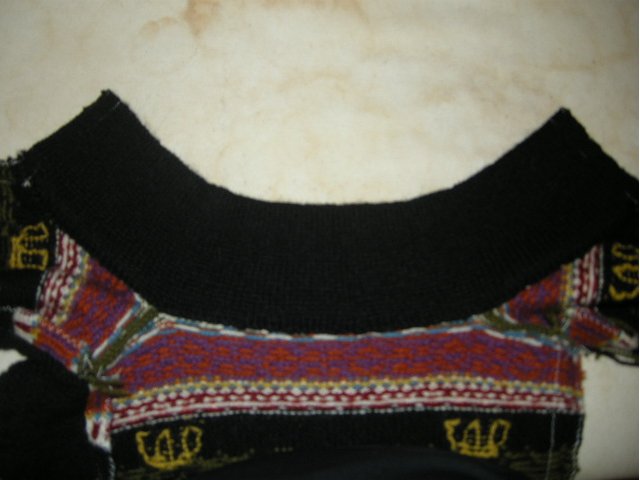
Here is the finished arc-shaped collar, complete with hidden neck curve edges.  It both fits a human neck and stands up, thanks to the combined powers of gauge and malleability.

In case you are wondering, no, it wasn't strictly necessary to make the collar at this stage of construction.  I could have waited until the very end just as well.  However, I decided that I would rather work the collar before the sweater had the added weight of sleeves.  Since part of the process requires swinging the whole garment around in little circles on size 1 needles, I elected to perform that feat before the sleeves were added.  YMMV.  

Join me for the next installment, in which sleeves grow sideways, cats and dogs live together, and things get a little bit weird. er.  
 

Steeky Fingers

First let me thank you, Gentle Readers, for weighing in with your opinions on seeing or not seeing the blood-and-guts process of making the Frog Prince.  It seems that most of you would like to see me break the eggs, in the hopes that I get an omelet.  It is rare that I can show you all the steps it takes to get a finished design.  Most of the time, my projects have been sold to a yarn company or a publisher before they are even born, and those people cleverly require me to keep my process under wraps until they are ready.  This project, however, I have saved especially for you.  Won't you join me on my Odyssey, and feel free to post questions as we go?

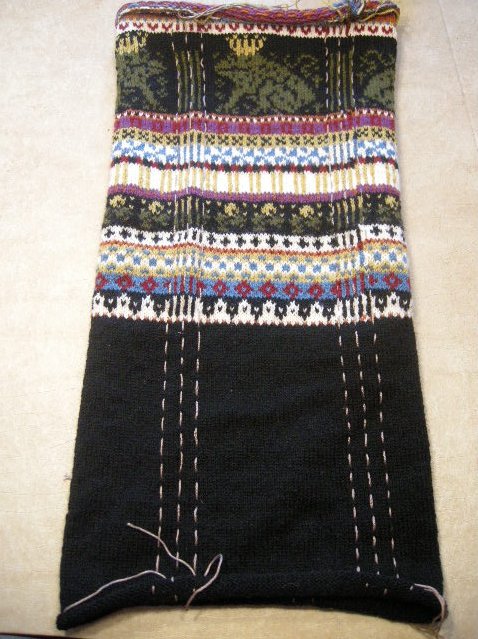
Here we rejoin the Frog Prince panel-tube in progress.  You can see my cotton yarn markers for the steek stitching and cutting lines. These are to help me see exactly where to stitch, and then cut the steeks.  Traditional construction would have only one vertical steek (in the center front of a cardigan), but since the Frog Prince is special (Weird?), it begins with a tube made of three conjoined panels, and three steeks.

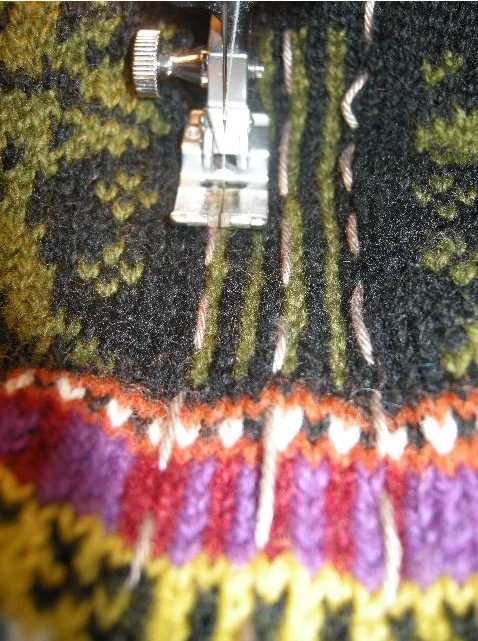
Here I am machine-stitching the first of 4 vertical lines made on each of the three steeks.  The machine-stitches go right down the valley between knitted stitch columns, securing the steek.  Pure Magic.  Steeks can be stitched in several different ways, each with advantages for various applications.  I chose to machine these, since I will be handling the raw edges quite a bit before finishing them.  A crocheted edge would be equally durable, but takes (me) a lot longer and adds more bulk than I need since it will ultimately be covered.

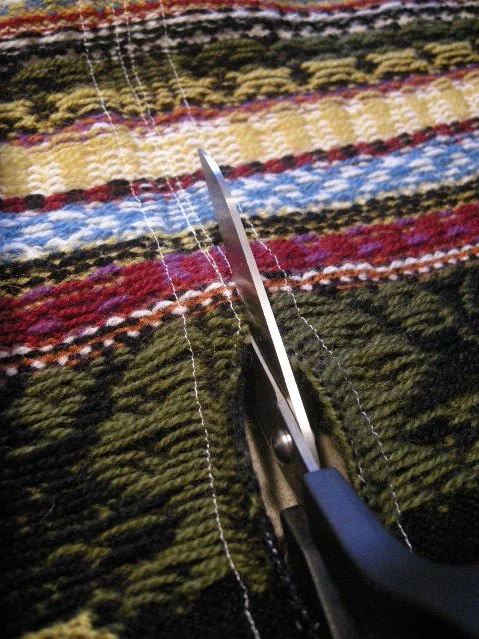
Warning: Yarn Carnage!  Sensitive viewers may need to skip this shot.  Braver souls will note that the 4 vertical stitching lines are clearly visible from the wrong side of the work.  I usually cut steeks from the back for this reason.  Any advantage you can get when scissoring a sweater, yes?  I slice right between the middle two stitching lines with extremely sharp dressmakers shears.  By the way, even though I have performed this maneuver many times, I still hold my breath.

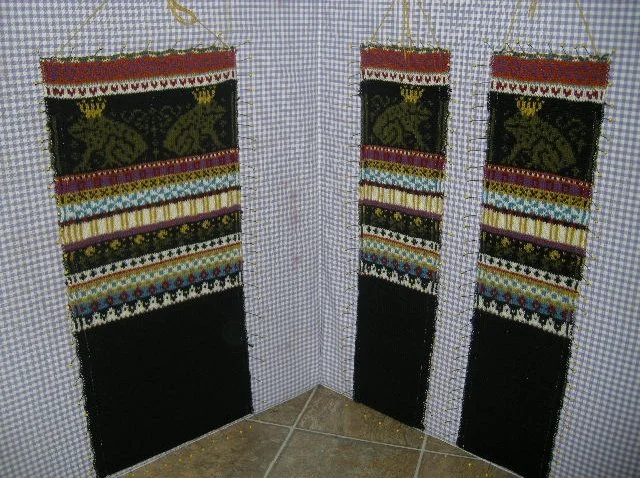
Eggs broken, Omelet Begun.  Here are the three Frog Prince panels, no longer conjoined.  I wash and block them just as I would any other sweater parts.

For those who have asked, this yarn is Rauma Finullgarn (translation = Fine Wool Yarn) from Nordic Fiber Arts, where you will eventually be able to purchase the Frog Prince Kit.  This yarn is the Real Deal, as far as Scandinavian knitting goes: Gorgeous, traditional colors, perfect stranding behavior, and just sticky enough to steek like a champ.  And we wouldn't expect any less from the descendants of the geniuses who made up stranded colorwork, now would we?

This is two-ply yarn, working up at a guage of 7sts/in on a US size 3 needle, in case you are wondering.

Join me next time, in which I plan to slash a throat.  Or shape a neckline.  Whichever.
 

I Solemnly Swear That I Am Up To No Good

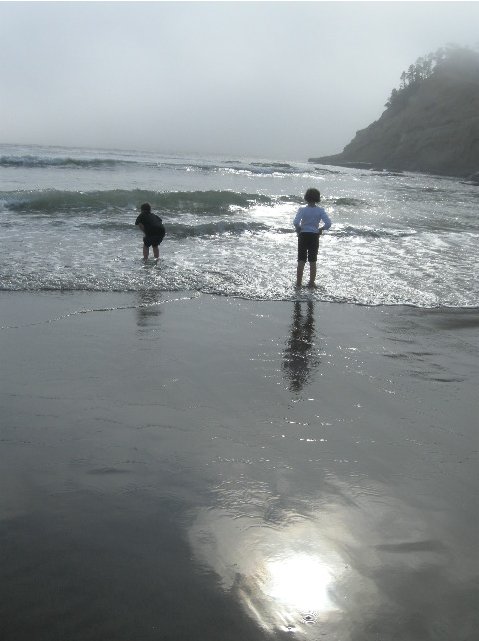
We spent the weekend at the beach, as is our custom at this time of year.  Right before school starts, all our best friends, their children and their dogs converge at Devil's Lake.  The lake is just inland from the mighty Pacific Ocean, where big fun was had by all:

Smallies in their native habitat: Wet and Sandy.

Smallies in their native habitat: Wet and Sandy.

Phillip got a Karate lesson.  He should be out of traction by spring.

Phillip got a Karate lesson.  He should be out of traction by spring.

Paisley made a new friend.

Paisley made a new friend.

And I knitted this

And I knitted this

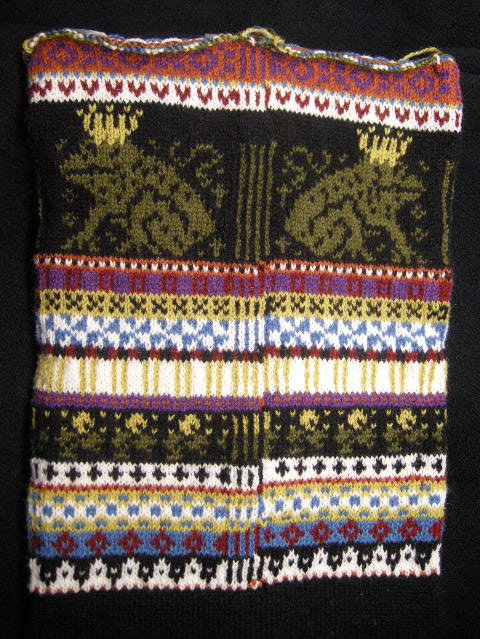
This is the way the Frog Prince begins.  I made three panels (two side fronts and a back) with steeks in between them, knitted in a tube.  Here you can see the two fronts, with their steek between.  Tonight I will cut them apart and block them, and then the real mischief begins.  The cunning plan is to join them at the shoulders, then pick up and knit the sides of the body and the sleeves sideways.  It's gonna be wicked cool.  I know because I'm still at the point in the project where nothing has been jacked up yet (that I have noticed), and the plan is self-concocting flawlessly in my head.  This is in many ways the best part of designing - I only have to think stuff up and make it be knitted.  It's communicating coherently to others how they can do it too that gives me trouble. 

Which brings me to a question I have for you, dear blog:  Would you rather not hear/see any of the Frog Prince process until it's all finished and available for you to make your own?  Or would it be useful/amusing to see the process step by step as I create the pattern? Kindly weigh in, dear readers, via comments.

I really wailed on the knitting this weekend, and I even managed to relax with my friends and family.  I brought along the copy of my book and tortured my poor indulgent friends into looking at it.  These are the very same suspects who were forced to watch me knit at every social event for a year so that the book could be written in the first place.  It was nice to be able to hold and point to the physical manifestation of all that.  None of these people are knitters, so a willingness to flip through the pages is more than I had a right to expect.  Lucky for me they are loving and supportive, so it doesn't matter to them whether I write about knitting, or Kung Fu, or cellular mitosis.

And I may also have made a sock, but I plan to deny it.

And I may also have made a sock, but I plan to deny it.