Crunch Berries

Over the weekend, the Smallies, the pooch and I headed up to Whidbey Island, where we all went feral for a couple of days.  The kids climbed rocks, played in the mud and skipped stones.  The dog dove headlong into a bramble patch in search of a cottontail rabbit.  Said rodent was actually behind her (I'm pretty sure laughing) at the time. 

And I worked on my Kingscot:
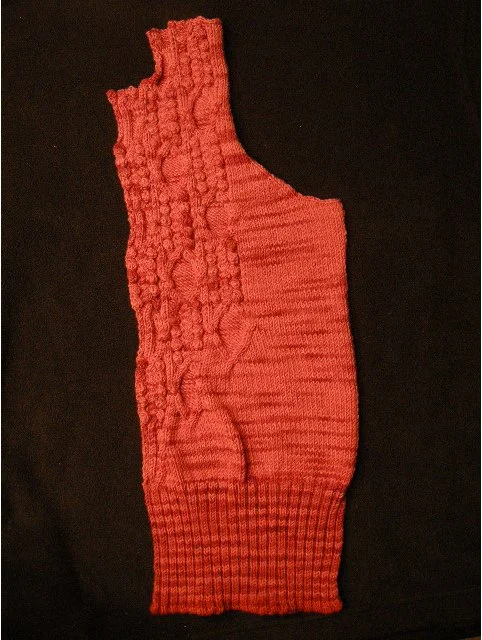

My sister, who is also plotting to take over the world, insists that the job can be done (get this!) without any knitting!  Bless her little feeble-minded heart!  She, like so many others, has no clue of the power we wield.  If only I could turn her to the dark side.  But Susie is the sort of woman who has "people for that", and sees herself as more the idea-generating sort.  The boring details, such as actual execution, are left to her people.  I'm sure I don't need to tell you that her people are often me.
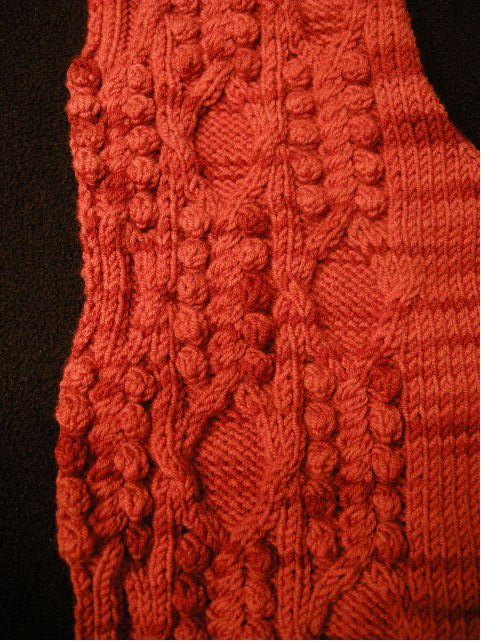
Susie watched me work a bobble on the cardigan front, with what I hallucinated to be interest.  I instinctively tried to teach her the technique, until I realized that she was looking at me with the kind of disdain usually reserved for mildew specimens.  "What?" I demanded.  "Nothing," she said.  "But those things look just like Crunch Berries."

I fear the New World Order under Susie's regime.
 

Making Knitting

Yesterday I took a short break from my Kingscot obsession project.  I kind of had to because I was beginning to experience signs of muscle strain.  I don't worry about injury as much as I should, but I do consider the consequences of an unreliable grip.  Even I will take a break if it looks like I'm in danger of dropping my wine glass.

Fortunately, I have a brilliant new distraction.  The Yarn Gods have been magnanimous of late, bestowing me with a bounty of things to play with, courtesy of a secret, but extremely well-loved, maker of string.

But why should I have all the fun alone?  Just because I'm not at liberty to reveal the source of the yarn doesn't mean we can't do show and tell.  Since I am frequently asked how I really work, today I'll share some of the process with you. 

As is often the case, this design begins with a very special yarn.  It's totally out of my usual gauge range, and a color guaranteed to make a grown knitter cry.  And something about it just grabbed me by the throat shrieking "Make Me Now".  Yarn never has to ask me twice.

Because this yarn's guage is so different to what I usually do, I uncharacteristically started from Square One.  I actually cracked a book.  And then I decided to Swatch.  (What madness is this?)  I elected to translate a cable from a stitch dictionary to a chart, since that is how I like to work best.  I do a better job of translation if I do it before I have memorized the pattern by actually knitting it.  Guess I take things less for granted at that stage.  I find this part of the process completely mind-numbing.  If there is ever a point in the work where I ask myself whose Big Fat Idea this was, it's at this juncture.  I trudged through by promising myself that I would get to touch the yarn as soon as the chart was done.  You know, Carrot, Stick, whatever it takes.

After the chart was done, I worked some plain old stockinette; so clueless was I as to what size needles would make what kind of fabric.  It felt like working rope with broomsticks.  Totally foreign, but not at all unpleasant.  Once I sized up the needles enough times to stop making chain mail, I took the new chart out for a spin:

I often know exactly what qualities I'm looking for in cables, so I choose really carefully, and I usually don't have to try many out before picking the winner.  Such was the case here:  This baby was a perfect match for the yarn.  Kinda modern, no?  I love how it works with the painting on the yarn, rather than competing with it.  If I had to analyze it, I'd say it's something to do with the open spaces between the cable ropes.  Fortunately, they don't pay me for my analytical skills.  I just know if I like something or if I don't.  That's the Big Magic:  Preference and Perseverance.

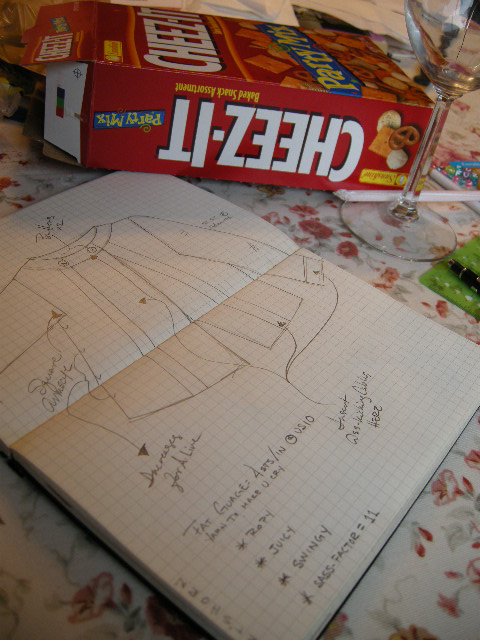
I knew before I started what silhouette this yarn wanted to be made into, so once I had the cable chosen, I sat down to draw the sketch before it all got away from me.  This part of the work always feels like flailing around with a butterfly net:  The idea is right there, if I can just sneak up on it and capture it before I lose my chance.  Sometimes I snack during this part.  A Lot.  That cracker box is nothing but an empty husk, my friends.  Okay, I just realized you can see the empty wine glass in this picture, too.  Just testing my grip.  Honest.

After the garment shape is roughed in, I dash down a few technical notes for myself.  These can be anything from notes on shaping to words that are in my head as I'm dreaming it up.  This fast and dangerous sketch is my road map for when it's time to knit.  There will be "real" drawings later - schematics that a person could really use to make a sweater with.  But those won't be possible for me to draw until after the knitting has been done.  And/or done wrong.  Just depends on the day.

I left it at that; happy with my pretty swatch pinned out to dry on an upholstered chair, chart drawn, working sketch made.  The next step will be to combine the elements into a proposal for the yarn company.  I'll use them all to present my vision of what the design will be, in a kind of collage that outlines the key elements.  After that, I take a deep breath and show the yarn makers, hoping  that they like the idea enough to move ahead.  This part is emotionally tough, because many projects die right there on the vine if they aren't what's wanted.  Or if I haven't presented them in a way that lets people outside of my head understand what I'm going for.  Always wonder about that: What if I had drawn a better picture?  Used more/less/better technology/pencils/hand puppets? 

But of course, that way lies Madness.  We can only do what we can only do.  I try to remember that while finished results are a big payoff, the journey of getting there is important and fulfilling, too.  In fact, I can't believe that I got to spend my day doing this.  Love. My. Job.

Casting About

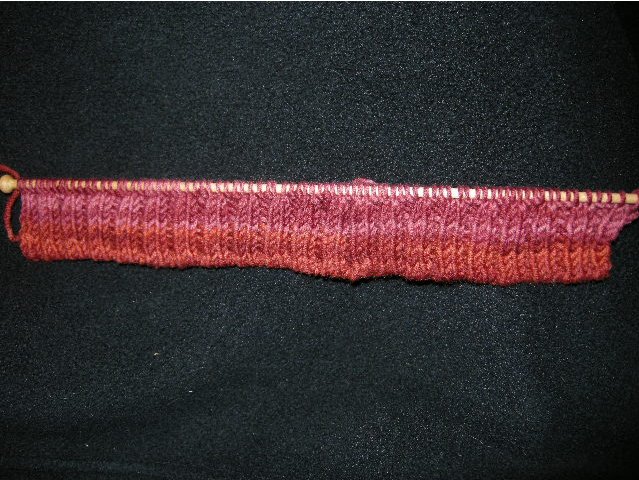
In my hysteria enthusiasm to start the Kingscot with my newly refurbished yarn, I managed a new trick.  My loathing for ribbing stems mostly from its inelastic (and inelegant) cast on edge.  And if I dislike 1 x 1 rib, I hate 2 x 2 at least twice as much. 

But there is no denying that the 2 x 2 rib used in the Kingscot cardigan is not only beautiful, it's an integral part of the silhouette.  So 2 x 2 it had to be, but I just couldn't settle for the usual cast on edge.  Enter my pal (okay, I've never met her, but she's sure given me a lot of cool tricks) Montse Stanley.  Montse maintains that there is no perfect cast on edge for 2 x 2 rib because they all slant unattractively.  This one slants as well, but I think it's as close to perfect as knitters have gotten.  Read on, try it out, and weigh in!  Do you know a better way?  Yes, it's fiddly, and there's that waste yarn to mess with.  But I think the end result is totally worth the trouble.  Here's how:

1.    Cast on 1/2 the number of stitches required, using smooth waste yarn.  Any old cast on will do - just get the stitches on.  This only works for even numbers; in my case, I ultimately need 80 stitches, so I cast on 40.

40 sts cast on in smooth strong waste yarn.

40 sts cast on in smooth strong waste yarn.

2.    Now purl one row:

One row purled.

One row purled.

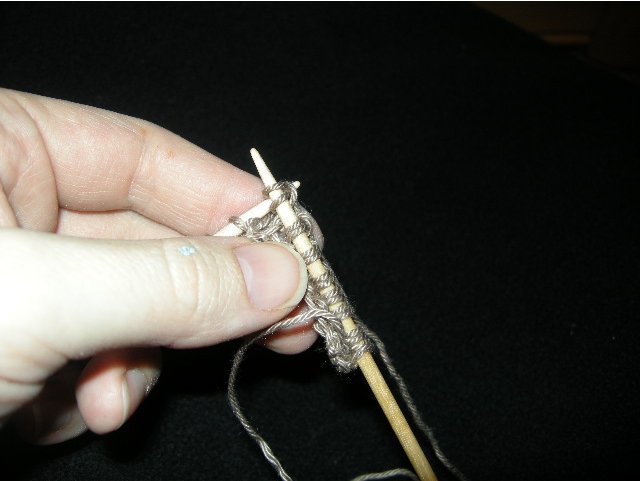
3.    Thus begins the fiddly bit:  Knit the next row, but instead of wrapping the yarn around the needle once as you normally would, wind it around a second time.  That's two wraps for every single stitch.

Knit row, with each stitch wrapped twice instead of the usual once.

Knit row, with each stitch wrapped twice instead of the usual once.

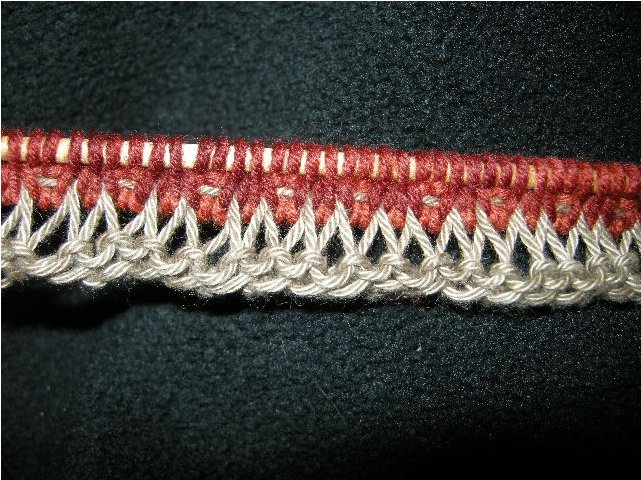
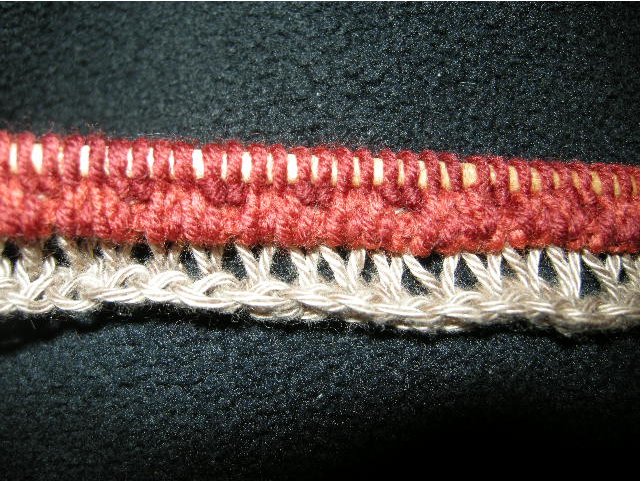
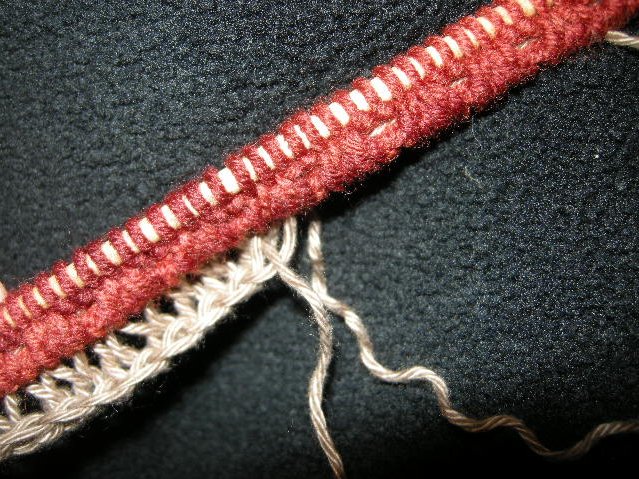
4.    Break the waste yarn and start working with your real yarn on the next row, which will be all purls.  Notice that as you knit into the twice-wrapped stitches from the previous row, you get great big elongated stitches of waste yarn.  These will help you in the next step.  Work a total of 4 rows in your real yarn.  You still only have half the number of required stitches (in my case, 40).

4 rows worked in real yarn.  Double-wrapped waste yarn row creates elongated waste stitches.

4 rows worked in real yarn.  Double-wrapped waste yarn row creates elongated waste stitches.

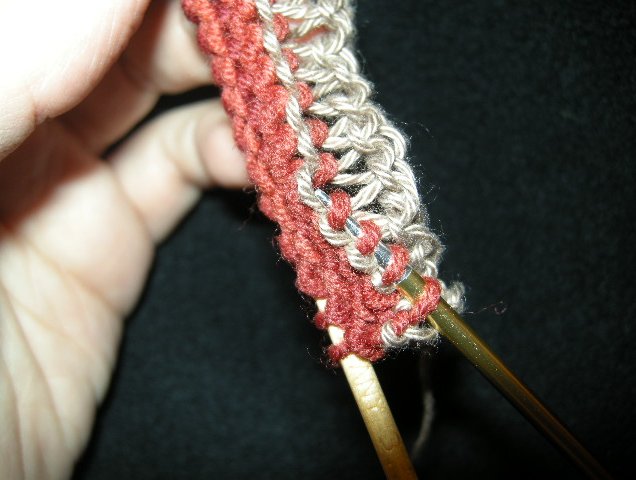
5.    Now find another needle a couple of sizes smaller than the one you are using for the ribbing.  Mine is a gold one in this photo.   Working from the wrong side, use your finer needle to pick up the purl bumps of real yarn from its first row.

Picking up the purl bumps of real yarn.

Picking up the purl bumps of real yarn.

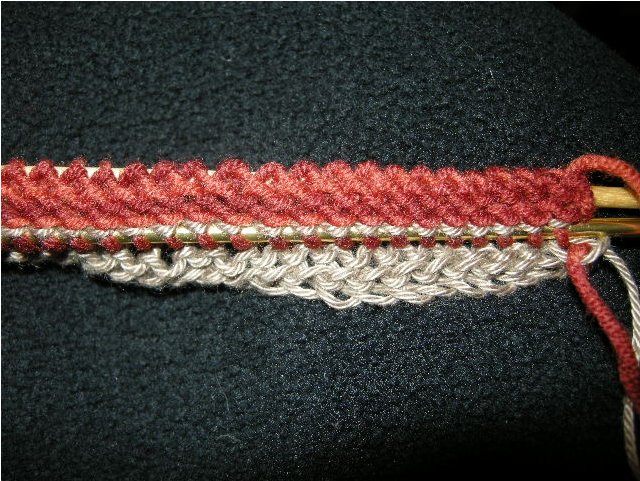
Keep going until you have picked up every single purl bump onto your finer needle.

All the purl bumps are now stitches on the finer needle (below).  Original needle is still in place (top).

All the purl bumps are now stitches on the finer needle (below).  Original needle is still in place (top).

6a.    Next, using the mate to your original needle (same size as the ribbing will be worked in), purl 2 sts from the top needle.

Purl 2 sts.

Purl 2 sts.

6b.    Now knit 2 sts from the lower (finer) needle, and repeat to the end of the row.

p2, k2, repeat to end.

p2, k2, repeat to end.

This is what it looks like at the end of steps 6a & 6b.  You have folded those first 4 rows of real knitting in half horizontally, into a tubular edge.

Kickass 2 x 2 tubular edge shown from the wrong side.

Kickass 2 x 2 tubular edge shown from the wrong side.

Kickass 2 x 2 tubular edge shown from the right side.

Kickass 2 x 2 tubular edge shown from the right side.

7.     Last, either cut or unknot the waste yarn and pull it out.

Waste yarn removal.

Waste yarn removal.

Continue in 2 x 2 rib as you normally would, but with a well-earned degree of smugness.

Totally elastic tubular edge, with no visible cast on loops at lower edge.

Totally elastic tubular edge, with no visible cast on loops at lower edge.

Fiddly and worth it.

Fiddly and worth it.

I will never approach hat edges or sock tops, or any 2 x 2 edge with fear or loathing again.  And now you, Gentle Readers, are free as well.  Knit Long and Prosper.