Kilt By Association
Of the three Scott daughters and the two Scott daughters-in-law in my family, I am the only one who can sew. This is a dubious distinction, since it means that the care and keeping of the kilts worn by our clan has fallen exclusively to me. I'm not complaining; I love Scottish clothing, and everything about the way it's made. I count myself as one of the keepers of my family history, and this is the way I do it. Some people archive photographs, some trace geneology. I look after the tartan.
I am fortunate to have learnt at the knee of some pretty fine tailors in my time. Some of them taught me to bag vest linings, One taught me to tie a ballet tutu (highly guarded trade secret: don't ask), from one I learned the gentle art of kiltmaking, and still another taught me to shorten a man's sportcoat sleeve in ten minutes or less. Be advised that this last is more about being swift with the needle than any clever tailoring tricks.
These skills, I felt confident, should have prepared me for altering the sleeves on my brother David's gorgeous new kilt jacket. For the uninitiated, a kilt jacket is very special, in that its proportions are specifically designed to follow the rules of kilt-wearing; namely that it has to be the perfect length in relation to the length of the kilt's pleat stitches. Too short and the lad wearing it looks like a bullfighter, too long and he's a Catholic school girl. David procured his stunning specimen in Scotland last year, where his tailor fitted it to his kilt with precision. The tailor was too behind on work though, to perform any sleeve magic before David had to go back to the U.S. Knowing what shipping a jacket from the UK would cost should he leave it for further work, and knowing that his sister loves him, David brought his jacket home to me.
Here is the first thing that happens when you have to shorten a kilt sleeve (okay, second; the first was a medicinal belt of Single-Malt to put me in the proper spirit): You gut the thing.

Here's the poor wee beastie with all 8 of its gauntlet cuff seams torn asunder. If you are at all clever, this process will cure you from any further interest in kilt-jacket-cuff-gutting. Nasty piece of work, that.
The next part is simple, but not easy: You have to cut into the perfect Harris Tweed fabric with your long shiny shears. You need both confidence and fortitude. Having cut open a few hundred sweater steeks is good preparation for this moment. So, in my case, was a second draught of Single-Malt. I needed it for spine-stiffening purposes.
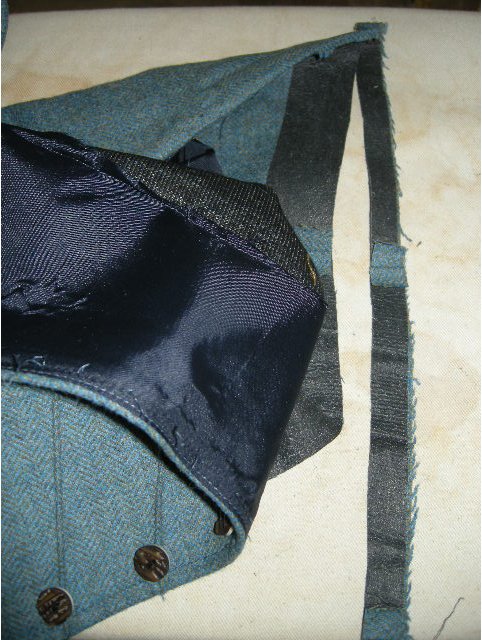
Here's the poor wee beastie with all 8 of its gauntlet cuff seams torn asunder. If you are at all clever, this process will cure you from any further interest in kilt-jacket-cuff-gutting. Nasty piece of work, that.
The next part is simple, but not easy: You have to cut into the perfect Harris Tweed fabric with your long shiny shears. You need both confidence and fortitude. Having cut open a few hundred sweater steeks is good preparation for this moment. So, in my case, was a second draught of Single-Malt. I needed it for spine-stiffening purposes.

This is a picture of the Tailoring Gods laughing at me to the point of Snot Bubbles. My hand, in this picture, is neatly inserted into a specially-finished slot in the kilt jacket lining. Prior observation of this slot's existence would have saved me opening and closing ALL 8 SEAMS. That's right, Gentle Readers: The brilliant Scottish tailor (factory seamstress, probably) who built this jacket had the cleverness to recognise that its gauntlet cuff faced a high probability of alteration. He/She cunningly included this inspired lining device, in order to save me and my ilk from preforming the very surgery that I had just done. I cannot believe the sexiness of this lining slot. I have seen many things that tailors do in order to save (and yes, torture) their brethren, and this one takes the shortbread. If only I had SEEN IT in time.
I'm blaming the Single-Malt. Everybody knows drunks can't sew.
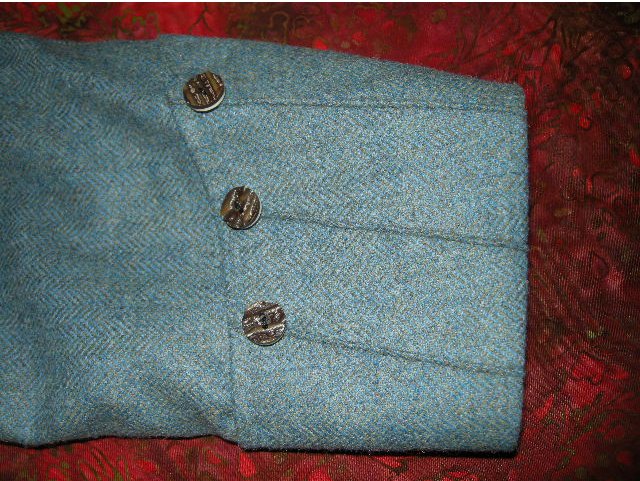
Looks pretty yar, if I do say it though. Calls for a congratulatory dram, I think.