Things We Have To Make

There are things we want to make.  Things we like to make.  Things we think that someday we would really like to make.  And then there are the things which are not optional.  Things which are required, by circumstance, as proof of our abilities, or in some cases, things which are born because not making them turns out to be much harder than just allowing them to form under our hands.

Lindsay had to make a sculptural interpretation of a cell, with all its parts.  She had a clear vision of what it should look like, its size, and all the things she would need to execute it.  My jobs were to drive to the craft store and help procure supplies, and later, to fire up the label-maker.  Other than that, this is entirely her creation.

I stood looking at it, the product of her hands and her mind, thinking that it wasn't very long ago that she didn't know how to feed herself.  What happened to that little baby who spit mashed peas on us?  Whence came this capable young lady?  Not sure, but it's okay; I don't really miss the mashed peas.

I was sick last week.  Gnarly bout with the flu.  I wallowed around in an antihistamine-induced fog, wondering if the cure wasn't worse than the disease.  My sensitivity to cold medicine (required for breathing) is such that it both knocks me out, and keeps me from actually sleeping.  So I lay around in a fugue state for about four days, dreaming the same irritating set of knitting instructions over and over, unable to release my mind from them.  This unmade garment, a colorwork vest, had commandeered my subconscious, and would not let it go.  I know where all the steeks go, the order of the colors, how many stitches are in it.  The only thing left is to let my hands catch up.

But I don't want to knit a vest.  I have other things to work on, like a Trapeze Tomten, and the Caorah Dubh pattern to write.  And I wont tell you (yet) about the the Annual Christmas Knitting Start-itis that has besieged me.  Nope.  I don't want to make the Vest of Flu-induced Torment.  Not One Bit. 

But I realized last night that I don't think its up to me.

One of my most constant prayers is for inspiration.  That said, I believe that Inspiration, in and of itself, is for amateurs.  As one who has hitched my financial wagon to the art that spills from my head, I cannot afford the luxury of waiting around for the big idea.  So I approach creation like the work that it is: Joyful, surprising, exhausting work.  And because I so often have to lower my horns and plow on ahead, it occurs to me that I may not know a real burst of inspiration when it's given to me.  And I don't get to choose how the ideas will present.  I might have to wait until some time when I'd rather be blowing my nose for the ten-millionth time. 

So I cast it on.

MacTarnahan inspected what  will one day be the Flu-Induced Vest Design. 

Lindsay had to make her cell sculpture for school.  Its completion was not optional.  She didn't waste time questioning its necessity, just dove in and made it.  And really enjoyed both the process and the result.


I'm gonna learn a lot from her.

A Wee Pretty Thing

I actually mean the scarf, but who am I kidding?  The model's pretty too.  I made them both, but not on the same day.  Only human, after all.  The model's Lindsay, and the scarf is my exclusive for next year's Madrona Fiber Arts Winter Retreat.

"Violets".  What could be sweeter?  The yarn here is none other than Socks That Rock Lightweight, made by the unsinkable Tina Newton of Blue Moon Fiber Arts.

If you like BMFA (and who doesn't?) you will LOVE this limited edition kit.  Tina's groupies (myself included) will recall that she doesn't usually produce kits, but she did me a special favor in this case.  We Love BMFA!  "Violets" measures 11.5" x 48", just the perfect length to snuggle under in late winter.  It's worked in the round, then steeked, for easy knitting. Big. Huge. Fun.

The kit costs $60 and is available one of two ways:

1.        Students who sign up for my Eeek! Steeks! class at Madrona will receive one in the mail upon registration.

2.        You can purchase a kit-only from the Blue Moon Fiber Arts booth at Madrona.  They will be available to non-students there, in limited number.  If you really really really want a kit and you're scared they might be gone by the time you make it to the booth (legitimate fear), send me an e-mail and I'll work with BMFA to arrange for a pre-order.  This will also help us know how many kits to create.  

If you attended Eeek! Steeks! with me at Madrona last year, you know what a great time we all had.  If you didn't get in last time, here's your chance.  This is only the second-ever Madrona exclusive design, so if you are planning to become a collector, don't miss the opportunity. 

For the die-hard, here is a list of the official BMFA colorways included (some are not yet available to the public):


Melusine:                The main background color - a "spirit" of turquoise; ethereal.
Mossay:                   The absolute best green in the whole wide world.
Tumbleweed:           Subtle and earthy; the perfect leafy foliage foil.
Saffron Surprise:       The middle of a fried egg.  The first crocus of spring.
Tanzanite:                A real and true, not even kidding Purple Gem.
Happy Go Lucky:     New this year; everything you ever hoped to find in your Valentine.
Vancouver Violet:     Delicate whispers of neither aubergine nor blue.  That secret place between sleep and awake.

Go on, you know you want one.  See you where the violets bloom.


Level Of Commitment

Last year, when I set about to process my very first raw fleece (still wondering what was in the water that day), I had an academic understanding of what steps were required, and what tools I would need to execute them.

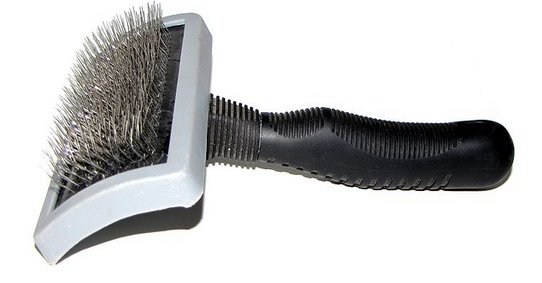
As with most endeavors, there are plenty of places where a beginning would-be fleece processor can cut corners and muddle through.  Don't have a big enough pan to simmer the locks on the stove? Disposable turkey roasters from the grocery will get you through.  Hesitant to spare $100 + for proper wool combs when you aren't sure you'll ever attempt fleece processing again?  Not to worry,  you can get by with a dog comb.

This one is very like what I used.  Its bent wee pins do an acceptable job of opening up a lock so it can be spun.  It will even remove some vegetable matter, leftover dirt, and short fibers.

As long as you don't mind accidentally removing the hide from your hands with it from time to time.  Hint:  When the bleeding starts, the combing should stop.  Oh, and once your hands are that torn up, you will have to wait for them to heal before you can properly spin again. 

And of course, dog combs wear out.  I mangled about four of these over the course of the fleece that I processed, and remember that half of that got thrown out, so who knows how many combs would have been required to do the whole thing.  The pins would all start breaking off, and I'd make another trek to the pet food aisle at the grocery.  Hint:  If you won't feed your actual DOG anything from the pet food aisle at the grocery, perhaps it's not the best source of fiber processing tools, either.  Just saying.


I was cognizant of these, and other limitations on my fleece-handling equipment.  But for reasons which escape me completely, I was not willing to cough up the dough for real wool combs. 

I am a knitter who will not flinch in the face of $55 sock needles, even though the $7 ones do a perfectly reputable job.  I waited till I could afford a very fine and very pricey spinning wheel, in spite of the fact that less expensive models are well known to produce string.  And don't even let me start in about yarn.  Suffice it to say that I have learned over and over again that if you buy great yarn, you may get great knitting.  And if you buy crap yarn, you will absolutely get crap knitting. 

So now that my first fleece project is well enough behind me to afford perspective, I am seeing the error of my ways.  Hindsight has provided the wisdom that I might not have required an entire year to comb out the locks if I had had tools that were made to do the job.  And here's the worst part: Fiscal Reality:  4 dog combs cost almost $50.  The salves, lotions and bandages I got to repair my hamburger hands added up to $65.  Already more than combs would have cost.  Add to that the opportunity cost of not learning what my beautiful fleece could have become under better tools. 

The answer comes straight from the pages of "DUH" Magazine:  Time to suck it up, Buttercup.

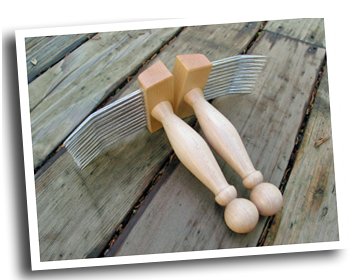
Here are the storied Forsyth  Mini Combs, sadly not currently in production.  Still, hope springs eternal...Carson has a pair, and he has to sleep sometime.
 

These are made by Blue Mountain Handcrafts , and come in this gorgeous mahogany/oak combination.  Don't they just make you want to touch them?  You can even get a special tine straightener, in case you have the bad luck to bend a tine.  Beastly clever.

This knockout set comes from the Benjamin Green Studio.  they can be used freehand, like the others, or you can clamp one to your table and use them in the style of larger comb-and-hackle sets.  Stunning.

I think I'm finally ready to own up to the place that playing with string now has in my life.  And I'm going to save a fortune on bandages.