Final Front Forces Placket Planning

I knocked out the Left Front over the weekend.  I *might* be on a little bit of a tear.  

And while it was drying, I started to play with how to make the front placket.  See, because I decided on a square neck, which will require miters at its inside corners, I've been thinking that I must also miter the outside corners.  Why?, you might well ask.  Umm, because I'm a spaz, and having one sexy mitered inside corner, and one boring picked-up edge right next to it is going to make my teeth itch.  And possibly my hair fall out in clumps.  I know my persnickety nature well enough to predict that this is one of those situations where I just want it how I want it.  So I grabbed my initial swatch and gave the outside miter thing a whirl:

Final Front 2.JPG

I initially thought that the placement of the top buttonhole adjacent to the miter would be the tricky part.  And I was right.  This one didn't land quite where I wanted it.  But the real problem turned out to be that my M1R and M1L increases on either side of the center st of the miter took too much slack out of the center st, pulling it in.  See how the corner isn't square, and both the top and side edges are slanting?  Since the buttonholes were also too close together, I pulled the whole thing out, trying to be glad that at least I'd tried it in small scale first.

And then I tried again, using different increases.  Which also sucked, so I pulled it out.

On the 4th or 5th try, I realized that I really didn't have to knit placket along the whole edge of the swatch: just the corner would suffice.  "DUH" magazine called to ask me to pose for the November cover.

I gave up in frustration (but not before viciously stretching and pinning the poor thing to the arm of the sofa, hoping it would "block out": Fail.)  The solution came to me in that foggy place between sleep and awake: The center stitch of the outside miter needed more yarn in it so the increases on either side of it wouldn't pull too tight.  So all I had to do was artificially elongate it.  Which I could easily do by wrapping the yarn twice around the needle when making that one stitch (which happens on the WS, just in case the whole thing wasn't fiddly enough).  But it worked:

Final Front 3.JPG

By elongating the center st when making it (on the WS), when I made the increases on either side of it on the RS, it shortened up to the normal size without pulling in!  Pleased with myself?  Little Bit.  I called "Knitting Show Offs" magazine to ask if they need contributions. 

They're gonna get back to me.  Really.

Sleeves at Season's End

Yesterday I tried racing the weather.  Our last bit of shiny October warmth was correctly predicted to end this morning.  And I still had two sleeves to block.  Not that it can't be done indoors, but it's never as fast, or delicious-smelling.  So I challenged myself to finish the second sleeve cap, and pin them both out before the sun set.

I made it.  Just.    

They were still damp when the sun went down and I had to move the whole works inside, but I still feel smug.

I can't believe how NOT tired of this stitch pattern I am.  It internalized really easily, and I love the rhythm of it.  I also love how I can just count repeats to see the landmarks for shaping: After 11 diamonds it's time for the armpit, etc.

The rain came this morning, and with it the end of the golden part of autumn.  It'll be strictly monsoons from now till next July.  I'm trying not to think about how it will be to watch Campbell's football practices, outside in the mud.  I *may* have ordered an enormously long down parka.  That will help a lot, but the real challenge is trying to knit while holding an umbrella.  I know:  First World problem.

I'll try to envision a solution while I knit the left front.  Indoors.


Heroes and Ravens

Photo by Mette Urdahl

Photo by Mette Urdahl

This is Annemor Sundbo, and she is my hero.  She saved Norwegian knitting for Norway, and for knitters everywhere, by rescuing a ragpile.  A great article that tells you more about her experiences is HERE, but the summary is this:  As the new owner of Torridal Tweed, a shoddy mill where wool was sent for reprocessing into comforter and sleeping bag filler, Annemor discovered over 16 tons of knitting, waiting to be shredded.  And a lot of that knitting was handmade.  And a lot of that knitting was the only record of the way Norway knitted.

Because she was a fiber artist who knew what she was looking at, Annemor saved, and studied and cataloged the treasures in her ragpile.  The journey of discovery she began in the early 1980s culminated last year in her being named an official National Treasure of Norway, and still continues today.  She spoke to the knitters of Seattle's Nordic Heritage Museum last weekend, and I had the great good fortune to meet her.

Photo by Annemor Sundbo

Photo by Annemor Sundbo

This sweater fragment was pulled from a gap in a wall, where it had been insulating against the cold.  Long past its usefulness as something to wear, it still was doing its job of keeping out the chills.  Annemor fell in love with its eight-pointed stars, which set her on her path of exploration of the symbolism of Norwegian hand knitting.

What was it like to meet my hero?  Nearly everything I would have hoped.  She held a mitten I was working on and proclaimed it good.  She asked what I was teaching.  When I responded that it would be introductory stranded knitting, she said she wished all the students could come to me first.  She graciously accepted a copy of my book from me.  I wanted so much to tell her what her heroic deeds have meant to me:

That without her I would never have learned as much about Scandinavian stranded colorwork as I have, living so far away from Norway.

That if she hadn't done what she did, Norway and all the rest of us might have forgotten how knitting used to be.

That the ripples of her actions have spread farther and wider than she ever could have imagined, changing my life , and probably many others.

Instead, I choked.  I gagged out something like "Thank you for so much for everything". and slunk away, because I was afraid I was going to cry, I was so overcome.  But before I did, I pointed to a photo in my book of the ravens I invented:

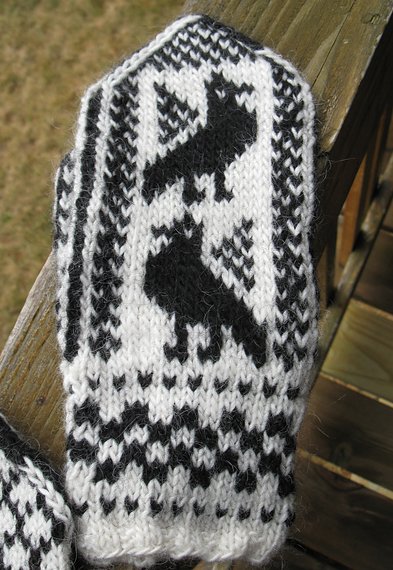
I wanted to show her somehow that we speak the same language, and I think she understood.  Here are Annemor's ravens; knitted long before I was born, by someone she never met:

For one of the VERY few times in my life where the power of speech abandoned me, I'm glad I at least was still able to point at a picture.