The 21st Century Called; I Finally Picked Up
movie camera.jpg

Luddite that I am, I've finally succumbed to the pressure and made my first knitting video.  Many thanks, Gentle Readers, to those who have suggested that I do this.  I'm sorry it took me three years to come around.  Of course, the longer one postpones these things, the steeper the learning curve becomes.  My day:

7:30 - 9:00 AM:    Employ various household items to act as stands under the tripod holding my iphone (settle on upturned flowerpot); adjust lighting (change bulb in dining room chandelier); wait for dishwasher to finish running (ample ambient noise provided by scottish terriers slurping water loudly off-camera).

9:00 - 9:30 AM:    Video takes 1-5 recorded.  Hate them all.  Start over.

9:30 - 11:30 AM:   Import video.  Learn that Windows platform will in no way recognize iphone clips.  Download programs 1-3 for file conversion.  All fail.  Download program 4 and successfully upload video.  Realize it's 11:30 and I have 25 knitting kits to mail before the post office gets busy.

11:45 AM:            Remember that it's Christmas, and the post office is never not busy.

1:30 PM:              Begin teaching myself how to edit video

1:35 PM:              Retreat to kitchen for a snack.  Realize that learning to edit video is about as far from knitting as my avocation has ever taken me.  Remind myself that when your job is to play with string all day, there have to be some trade-offs in the fun department.

1:45 - 6:45 PM     Finally start to feel like I'm getting the hang of the video thing when Phillip announces that dinner is ready (thanks for throwing yourself on that grenade, Dear).

7:00 PM              Ask Lindsay what she's been doing up in her room.  "Making and trading videos online with my friends."  "Oh, really?  Videos?  Like, with a camera and everything?  When did you learn to do that?" I ask. "Oh, fourth grade, I think."

7:01 PM              Resolve to hire a 13-year-old Producer.

Ironic cruelties of the Universe notwithstanding, I did manage to get the thing online.  For those who are knitting the Wild Hare mittens, and for the merely curious, I present:  Knitting A Bobbled Cast On.  Enjoy!

Oh, and in case you're wondering, the Wild Hare knitters have raised over $700.00 for Judith Mackenzie's studio rebuilding effort.  Thank you all, sincerely.

Dicentra's Doyenne of Dye

Lisa Millman of Dicentra Designs loves us, Gentle Readers.  And I can prove it:

No less than FIFTY (50) pounds of yarn, lovingly skeined and meticulously sorted for my Eeek! Steeks! students' homework kits.  You are going to LOVE this yarn.  I promise.  And more than that, you're going to love knowing more about Lisa.  The only thing better than gorgeous yarn is feeling a little closer to the artist from whose hands it comes.  Lisa graciously agreed to let me interview her:

How long have you been dyeing?

I've been dyeing seriously since around 1996, so about 16 years (wow, it doesn't seem like it's been that long!)

Where do you live?

Just outside Dallas, Oregon (also known as "Little D") in the foothills of the Coast Range on a nano (smaller than micro) farm.

Got any kids/pets/houseplants/partners you share life with?

No two-legged children. Two four-legged children (dogs BB, a beautiful German shepard mix, and Xena, a small black Labrador). Partner: Alex, a writer and idealist. Houseplants: a 16' x 10' greenhouse/leanto shed filled with epiphyllums, which are tropical cacti with flat, long, straplike leaves that live high up in trees and make gorgeous, giant, sometimes fragrant blooms once or twice a year, including night-blooming cereus and a bunch of hybrids that have large colorful blooms once in awhile.

What's your day job?     Land use planner.

Is your family here in the NW?

No. I have a niece in San Francisco, brother in Maryland, sister and mother in Maine. I'm a true Yankee born in Connecticut and raised in New Hampshire. I migrated to Florida after graduating from college in the 1970s and then set my sights on the West Coast about 17 years ago.

What would you do if you ever got spare time?

I'd travel. Iceland and Middle Earth, otherwise known as New Zealand, are high on the list. Go to Europe and Australia to do some felting and dyeing with the excellent artists who live there. Also, I'd spend a lot of time making felt, spinning, knitting, and weaving the fiber I dye into works of art and exhibit the art in galleries.

Anything you'd like to tell the knitters about the process of making these gorgeous kits...

Hmmmm, dyeing the yarn for these kits has been so much fun, in part because the colors are tints, tones, and shades of my two very favorite hues: green and purple. Some of the colors are old favorites, and I also came up with some new colors I haven't used before. The range of tints needed for the kits challenged me to come up with some very pale colors, which I don't do frequently, to the midtones and saturated jewel tones that I most love. I don't often dye on commission, usually preferring the freedom of responding to what I am seeing outside in my yard and on hikes in the woods, music I am hearing on the radio, and occasionally even checking color forecasts for the fashion industry and translating those into color on wool and silk. The challenge of talking about color with another person was made easy in part by the clear and well thought out initial draft of the project we started with and the creative space I was given to interpret the thistle motif in color. The beautiful charted thistle pattern instantly got my creative juices flowing and the thistle photograph that came with it was the perfect starting point for choosing the particular purples and greens that would complement the design.

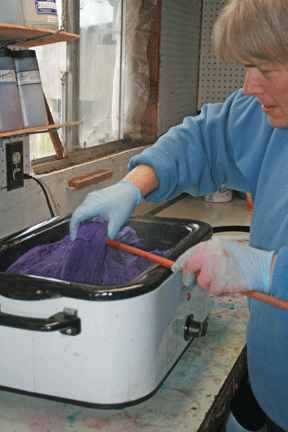
I have converted a wood shop into a dye studio with three electric stoves, and an electric roaster I use for sampling colors and dyeing small quantities of fiber and yarn, along with a washing machine used to rinse the dyed fiber and yarn. I dye in fairly large batches and can get around 36 pounds of yarn steaming at a time at full capacity. In the winter, the yarn comes inside the house to dry, looking like stalactites hanging from the ceiling in the room with the pellet stove. At almost 2 pounds of yarn per kit and 39 kits and counting, about 70 pounds of yarn needed to be dyed in 6 colors, and then wound off into the amounts of each color needed to complete the Thistle Stole. At this point in the Thistle Stole Project, most of the dyeing is done and the 3-skein electric skein winder is whirring in concert with three umbrella swifts to produce the 234 skeins needed for the kits.

Now I'm thinking about all the stunning Thistle Stoles that will be created from these kits, each with its own particular personality influenced by all the hands that touched the ingredients, and proud to have a part in bringing some loveliness to the world.

CLICK HERE to Visit Dicentra, and be sure to check out the "Shows and Shops" tab to learn where Lisa will be next.

Dear Mom, It Wasn't Your Fault

My mother fell in love with Cowichan sweaters in 1978.  It's taken me until now to appreciate them, but having seen Sylvia Olsen's collection this fall, I now understand how she felt.

I remember Mom's Cowichan odyssey, because even though I was only 8 at the time, her hair-tearing, blue-streak-cursing, battle with the Gods of Gauge left a permanent mark on me.  Looking back, I can't believe I ever wanted to knit, myself, after witnessing the carnage.

It happened to Mom, as I recall, like this:  She came into a large quantity of sale-table yarn.  And by large, I mean to say that she bought all they had.  There were varied amounts of at least six earth-toned colors in the clear plastic bag she stored it in.  The plastic bag, I remember, had been the original packaging for a Queen-sized down comforter, to give you an idea of the scale here.  Her ambitious plans called for no less than three Cowichans, I remember.  Mom was not one to do things by half. 

Her tactical plan was to knit the biggest specimen first, for my dad, then a smaller one for her, and the smallest one for my older sister, who would then allegedly pass it down to me.  She dove in with gusto, dragging the bag of yarn (all of it) with us on the boat, where we spent every weekend, and at least two solid weeks, that summer.  Let me tell you, with four people and all the gear required to live that long on a 32' cabin cruiser, the space allocated to mom's Yarn Bag was prime real estate.  Such was her devotion to the Cowichan Project.

Being only a kid, I failed to grasp the significance of her announcement, sometime in late June, that this sweater was going to be for her instead of for Dad, because it seemed like it was turning out smaller than she'd expected. 

It was mid-July when Susie, my 13-year-old sister was deemed the sweater's rightful recipient.  There was still lots of yarn in the bag, after all, so the tension in Mom's voice during this proclamation wasn't the worst we'd ever heard.  Although, Dad, having fallen over the yarn bag more than a few times on the deck of the boat, was forming somewhat vocal opinions about knitting, yarn supplies, and Indian Sweaters in general.

It was the bitter end of August when Mom finished the Cowichan.  It was going to be given directly to me; Susie having inexplicably "filled out" while Mom was engaged in her cage match with the cardigan.  I donned the thing triumphantly so she could mark the buttonholes.  Its edges failed to meet in the center of my 8-year-old torso.  It was also surprisingly long, hanging almost to my knees.  My mother, undaunted (or more likely in a rage-induced fugue state) created a set of front bands on the thing which was quite wide, indeed.  And this I remember, but not the reason why:  She crocheted the plackets, rather than knitting them on.  Was knitting dead to her at that point?

Ultimately, she considered the project a triumph, because Mom was always way more of a starter than a finisher.  Having completed the beast, size notwithstanding, she had the last word.  There were no other Cowichans, after that.  She referred to this as "quitting while I'm behind".  The yarn bag hung around Mom's house for decades, though.  Child of the Great Depression that she was, she didn't get rid of it - though I suspect she could always hear it mocking her.

I forgot all about Mom's Summer of Cowichan Discovery, until I went looking for vintage Cowichan patterns on my own.  It was then that I saw and remembered this face:

It was HIM, the Prince Valiant-haired Canadian boy, who had taunted my mother for all those weeks on the boat.  I'd recognize him anywhere.  I bought the pattern and waited an insufferably long time for the international post.  When it finally came, I applied all my forensic knitting skills to the question of how it had nearly bested Mom. 

To begin with, she had the wrong yarn.  Hers was bulky, but not the 6-strand unspun super-bulky she would have needed.  Could've happened (and has) to any of us.  The instructions are predictably vague, too, and partly in French.  No wonder Mom couldn't get the gauge right, if she even knew it was important. 

I'm so pleased to have finally solved the mystery what went wrong with my Mother's knitting in the summer of 1978.  I feel strangely bad that the grown-up knitting teacher Me couldn't be there to help her back then.  Maybe it's the memory of my helplesness in the face of her frustration that made me a knitter, after all.  My cunning plan is to reknit the Cowichan, Her Cowichan, at the proper gauge, to vindicate her struggle.

This yarn is no longer in production, but I'm sure You, Gentle Readers, can offer some substitution ideas?  What's your Cowichan Story?