Paperwork

Last summer I embarked on an odyssey to replace the worn-out flooring on the ground level of my house.  Using nothing but paper, glue and varnish, I replaced the flooring in my powder room, kitchen, and the landing between my dining and living rooms.  And then I ran out of varnish.  And gumption.  It was autumn by then, and time to start knitting (thank God).

Even though the dining room floor was still un-refurbished, I tried to think of it like one does a garden:  You shouldn't expect everything to happen in one season.  That, and I also tried not to look down when in the dining room, which it turns out is harder than you might think.  Leaving the dining room floor alone has required a level of patience I didn't know I had (Thanks, Knitting!).

You can imagine my delight when, at the beginning of Spring Break, Phillip suggested that we finally finish the dining room floor.  I wasted no time in mobilizing Team Huff.  Together (with varying degrees of enthusiasm), we dragged the dining room furniture out into the back yard and demolished the old vinyl flooring:

Lindsay supervising the gentlemen

Lindsay supervising the gentlemen

There is something SO cathartic about tearing up your house.  I highly recommend it as a thrill-seeking behavior (provided the part you are tearing up is yucky).

After the demolition, things moved ahead really quickly.  Since the dining room contains a major traffic path, I papered the floor on either side of the main walkway, leaving a narrow path for the teaming hordes.  Once the areas on either side of that were dry, I was free to finish the narrow naked strip. 

At which point I ran out of paper, and bought a new roll.

Um...Notice anything different here?

Um...Notice anything different here?

Of a totally different brand of paper, from the absolutely wrong store.  I can't believe I completely forgot which store I got the first roll from, almost a year ago. 

And while I could just barely tolerate the nasty old worn-out vinyl for nearly a year, having two different colors of paper on the dining room floor was profound and exquisite torture for me.  I mean torture like wearing your 4-inch stilettos on the wrong feet.  Steel wool lingerie.  People who say "EX-presso".

But there was nothing I could do about it until I could figure out where that roll of original paper came from.  Fortunately for me, there are only a couple of places I would have found brown builders paper last year: the big home improvement stores; either the Orange one or the Blue one.  Since the wrong paper came from the Blue store, I would have to go check at the Orange one.

It took a full two weeks before I could synchronize time, money and vehicle to visit the Orange store.  During which time I'm pretty sure most of my hair fell out from the stress of my mismatched floor.  When I finally got there, the rolls of brown paper stirred no recognition.  There is a gaping hole in my recollection of last year's supply acquisition.  I stood in front of the pile of brown paper rolls, helplessly pounding on the locked door of my memory. 

And then something happened that I cannot explain:  I flinched.  What if this is still the wrong paper?  What if they've stopped making the paper from last year and I can never find it again?  I surprised myself totally by grabbing the loose edge of the nearest roll and tearing off a piece.  I stuffed it in my purse and departed apace.

Once home, I glued my ill-gotten swatch down next to the place where the right and wrong papers met.  And I waited for it to dry.  And waited.  And waited.  I wondered what circle of Hell is reserved for brown construction-paper thieves.  I felt genuinely bad about snatching that piece of paper off the roll.  I prayed to the Gods of Home Improvement, hoping they are less capricious than those of Knitting.  I promised them that if the paper would please just match, I'd go right back to the Orange store and make amends.  I prayed that the roll I had molested in my moment of panic would still be there on top of the pile, so I could purchase it and reunite it with its kidnapped swatch.

And I think they heard me, because that little stolen swatch is a dead ringer for the rest of the floor.

Which is a good thing, because my conscience overcame me in less time than it took the stolen swatch to dry.  I went tearing back to the Orange store, where the rest of the roll was still mercifully waiting for me.  I paid for the roll, matching or not.

So now I can finish putting things right in the dining room, and my conscience is clear. 

It's funny; I never would have expected to get more matching supplies later if this had been a knitting project.  I would have bought all the paper needed for the whole ground floor last year, if I had been using the knowledge I already have in place for my knitting life.  Weird how the brain partitions things.  And forgets them. 

If anybody needs me, I'll be where I so often find myself: On my hands and knees.
Mi Scalloped Border es su Scalloped Border

I only know a few key phrases in the Language of Lace, without any real mastery or context (and my accent is probably terrible).  I'd say I'm just fluent enough in Lace to order a beverage and locate the loo.

Fortunately for me, a little lace goes a really long way most of the time, so I use it with restraint, and repeat elements wherever possible, for continuity and cohesion (or at least, that's the goal).

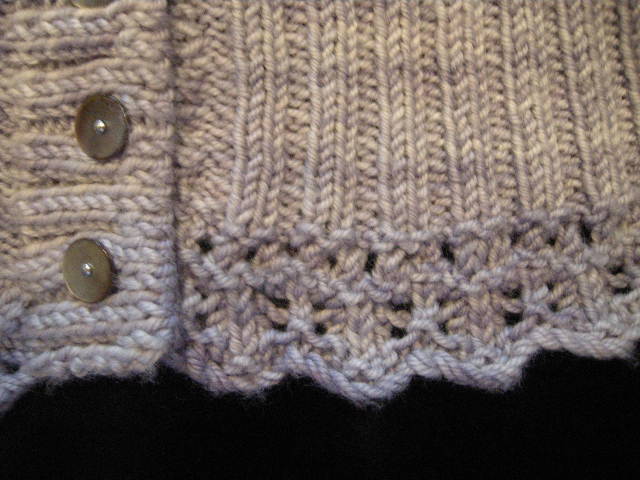
Case in point:  Gentle Reader Millie sweetly asked about the border I used in my EPS cardigan, which made me think you might like to experiment with it too.  It's super-simple, and the repeat is so short you can easily stick it just about anywhere.  I combined mine with 2 x 2 ribbing, but there are lots of other ways and places to use it.  Here's the chart for you (feel free to reproduce and share):

Mi Scalloped 2.jpg

Cast on a multiple of 6, plus one.  Row 1 is worked from the WS.  My photo shows a cable CO, but long-tail would be pretty, too, and has the advantage of starting with the WS facing for the first row. 

Remember that this needs to be worked from the bottom up, so if you want to put it on the cuff of a sleeve, like I did, you'll probably want to work that sleeve from the bottom up, too.  I thought of that too late and had to resort to grafting acrobatics.  Oops.

Other than that small requirement, you'll find that this is a very well-behaved little edging; one that will be welcome in lots of interesting places.  Where will you find to put it?

EPS, a la MSH

Meanwhile, back at my Elizabeth's Percentage System test laboratory...

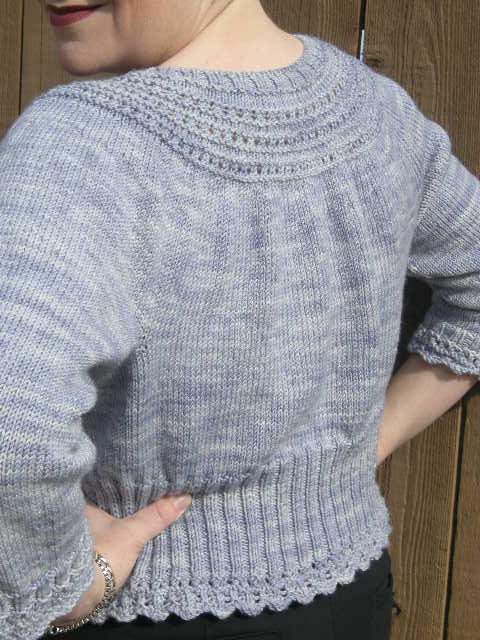
When last I updated this project, things were looking bleak in the yarn supply department.  As in, I was running out fast.  I had finished the body by adding 1" long sleeves, with the intent to make them however long I could at the end.  I finished the neckline and plackets, then divided my remaining yarn in half, to finish each sleeve from the armhole down.  Then I realized that the edging I wanted on the cuffs had to be worked from the bottom up.  So I worked one cuff edging from each half of my sleeve yarn, then set them aside and hoped for mercy from the Knitting Gods. 

I worked from the armholes down on each sleeve, then grafted the cuffs on, hoping to end up with a sleeve length that was in any way wearable. 

Here's an action shot of the graft:  A combination of DPN, circulars and one lone tapestry needle to get the job done.  Desperate times call for Desperate measures.  Fiddly much?  I'm pretty sure I didn't exhale the whole time.

And then I ran out of yarn, one round short of the second sleeve's end. 

Trying not to cry, I grabbed my purse to storm out of the house.  Not sure where I was headed, just OUT.  But the car keys were in the other purse; the one I had just changed out of the day before.  And so was this:

The remains from when I wove the ends in on the main body.  I don't even remember where I was when I wove them in - somewhere without a garbage can though - or I wouldn't still have the ends in my purse.  When spit-spliced together, they added up to exactly enough to knit a round and graft on the second cuff.

Say what you want to about those Knitting Gods, but sometimes, just to keep us wondering, they are kind.

Oxygen deprivation notwithstanding, this was a really good exercise for me.  I followed Amy Detjen's short-row insertion strategies (Originally Elizabeth Zimmermann's, perfected by Meg Swansen, and tweaked for prime time by Amy), and they really really work.  Follow Amy around the country to where she is teaching, or take her class on Craftsy to soak up some Genius.

I finally understand where the short rows have to go and why (different for every person's body), and best of all, I've cracked the code to putting a circular yoke on my own very square shoulders (Don't be in a hurry to start the yoke decreases!  Suck it up and keep knitting longer than you want to after joining the sleeves). 

Do I wish there had been less fabric in the main body so there could have been longer sleeves at the end?  Yep.  Do I wish it were a little longer, overall?  Affirmative.  Do I still love the color of the yarn enough to wear this in spite of not loving 3/4 length sleeves? Yes, and Yes.  Wearing a long-sleeve t-shirt under it compensates for both the length deficiencies. 

And let's not forget:  The goal was to get a whole sweater out of exactly three skeins of yarn, which I did.  Yay Me.  Oh, and the other trick that never fails:  Use more buttons than are usually called for on a cardigan front to avoid Gap-osis.  I have 11 here, when there would normally be 5-7.  And make sure there are an ODD number, no matter what.  Because it always just looks better that way.  These are antique shell, with a super-cute exposed shank attachment. 

This is the perfect time of year to make an abbreviated cardigan.  In most parts of North America, we still want a sweater on most of the time, but a short one like this affirms your belief in the promise of Spring.  Why not try your own EPS sweater?  I promise you'll learn a lot.  But please, do make sure you have enough yarn first.