Time to Let Go

Yesterday I sent my finished manuscript to my editor.  It was not unlike kicking one's offspring out of the nest.  Time to fly or fall, little book. Don't forget to Flap!

You know how when you finish a really terrific knitting project, you don't know what to do with yourself for a while?  Getting your life back from book writing is a lot like that.  I keep noticing gross chores around the house that nobody has done since I started the book, and thinking that now I don't have any excuse for not doing them.  Super-nasty ones, like cooking dinner.  

I gotta dream up a new project, STAT.

But since this is the third book I've written in 18 months, I'm going to take a wee break first, in order to recharge.  My family and I are invited to the lake for some R&R, which is most welcome. I'm looking forward to spending the last little bit of summer doing actual summertime things.

At least until I look down and realize there is no pile of wool in my lap.

Making New Knitters

The Knitting Lesson, by Hendrik Johannes Haverman, Amsterdam, 1857-1928.

I've been working on a book about knitting.  Specifically about adults and kids knitting together, which is a subject close to my heart.

This project calls for me to think like a new knitter, and remember what mattered most to me when I was first learning.  Since that was a long time ago, I've relied pretty heavily on my family, as newly-minted knitters, to keep me on track.

Lately I've gotten a little bogged down by the responsibility of it all.  It's such a privilege to pass on the thing you love.  The things we treasure are also our burdens to bear, if we care deeply about what happens to them.  But that's a pretty heavy point of view for a kids knitting book!

I mentioned this to my friend Karen F. who reminded me of one important thing:  No knitting book can have everything in it. 

Of course, she's right.  If anything, I should be making sure that the content is streamlined enough not to be intimidating.  Thanks, K - for saying the right thing at the right time.

I wonder if this means I should cut the chapter on Icelandic lace?

What I Made at Camp

Did ya miss me?  I've been away at summer camp!  Hosted by Freedom Kilts in beautiful Victoria, BC. I attended Kilt Kamp with Barbara Tewksbury last week.  We learned the art and science of traditional kiltmaking, under Barb's expert tutelage.

Traditional kilts are sewn completely by hand, and contain anywhere from 4-9 yards of fabric. The tartan weighs 16 oz per yard, so it's no wonder that an 8-yd kilt (like I made) is often referred to as a "tank". Dinnae fall in the Loch. 

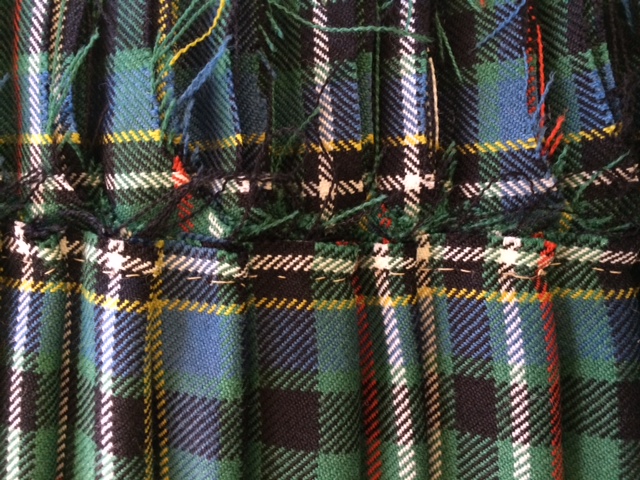
Every kilt is custom made to precisely fit the measurements of its wearer.  At the same time, the pleats have to be engineered to exactly accommodate each tartan's unique weave.

The tartan I chose is Scott Green, in an Ancient colorway.

3 whispering.jpg

The first step in making a kilt is to do some "tartan whispering". The maker has to determine what the pleating options are for that particular tartan, making sure that none of the rules for how to pleat are being broken.

4 pleating.jpg

Then come the layout (measuring, re-measuring, marking and basting) and pleating phases.  My kilt has 20 pleats, but there can be as few as 15 or as many as 30, depending on the pleating style and the tartan.

5 feet.jpg

8 yards of heavy tartan are a lot, when the temperature is 90 degrees F. Our workshop went "shoes-optional" right away.

6 barb pipes.jpg

Each evening Barb retired to the tennis court opposite the kilt shop to practice piping.  At which she is also an expert. Not to mention a fashionista - get a load of those sassy tights!

For some reason, I was the only camper who had matched my pincushion to my tartan.  Who knew?

See the horizontal line of beige stitches at the top of the pleats?  That's the STEEK.  Yep, knitting stole the word from kiltmaking.  It's Scots Gaelic for "secure" Thanks, Scots!

10 stabilizer.JPG

Every kilt has a hidden piece of cotton broadcloth installed at the waistline to stabilize the pleats.  Since Barb is an American, she always uses this print, which she kindly shared with me.

In addition to the steek and the stabilizer, kilts are reinforced with heavy canvas interfacing, which is also pleated, for even more rigidity.  This causes the back of the kilt to hug into the small of the wearer's back, not unlike a weightlifting belt. It feels fantastic to wear.

12 barb buckles.jpg

Barb shows me how to choose the right scraps of fabric with which to attach the buckles. The straps have to match the tartan exactly, even though they are invisible when the kilt is buckled.

Putting the lining in my nearly-done kilt.  Fingers flying too fast for photos.

15 finished.jpg

Done. And. Done.

All the Happy Campers, on the front porch of the kilt shop.

Kilt camp lasted 5 days, with most of us campers working 12 hours or so each day.  Although an experienced kiltmaker can complete a kilt in 20-40 hours, we newbies were much slower.  Of the 10 campers attending, I was the only one to finish in 60 hours.  

So am I ready to hang out my shingle and become a real kiltmaker? Sadly, not even close.  I need some more practice first.  

Which should not be a problem, because my family are already placing their orders!

Want to learn more about the making and wearing of kilts?  CLICK HERE, and have fun.